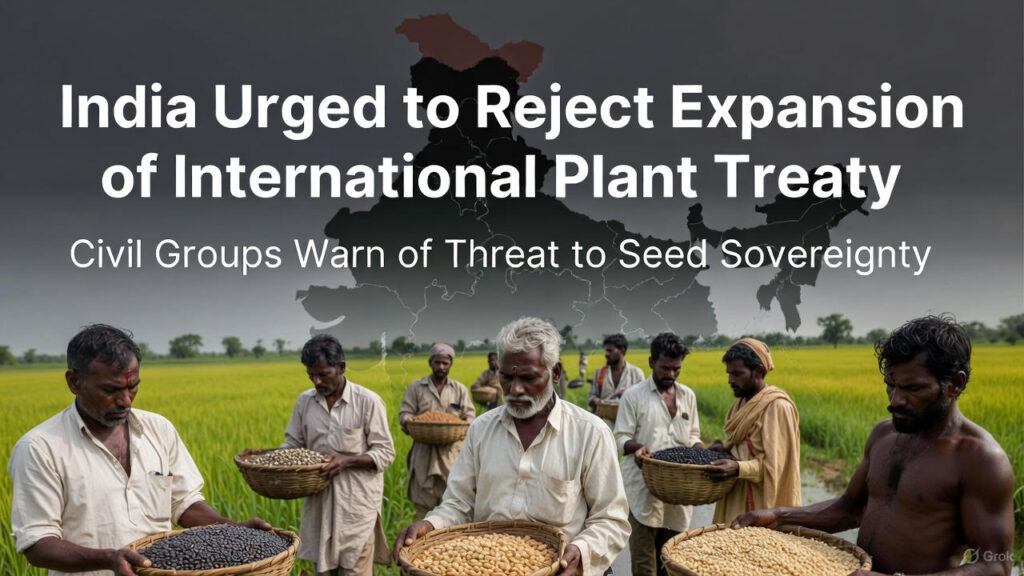
Civil Society Groups Warn India Against Proposed International Plant Treaty Amendments
Civil society organizations under the Alliance for Sustainable and Holistic Agriculture (ASHA) have strongly urged the Indian government to reject proposed amendments to the International Plant Treaty (ITPGRFA). According to these groups, the changes—scheduled for discussion at the 11th Governing Body meeting (GB11) in Lima—pose a serious threat to India’s sovereignty over agricultural genetic resources.
In a formal letter submitted on 15 November 2025 to the Union Ministers of Agriculture and Environment, ASHA warned that the proposed expansion of the treaty’s Multilateral System (MLS) would undermine national control over seeds and biodiversity.
Proposed MLS Expansion Could Expose India’s Genetic Resources
The most contentious proposal at GB11 is the plan to expand the MLS to include all plant genetic resources for food and agriculture (PGRFA).
According to civil society groups, this would effectively open the door for multinational seed corporations—primarily from developed countries—to access India’s rich seed diversity without adequate safeguards.
The letter states that Articles 11, 12 and 30 of the treaty prevent countries from making reservations. This means that once India accepts the amendment, all agricultural genetic resources must be shared, contradicting India’s own Biological Diversity Act (2002) and PPVFR Act (2001), which safeguard farmers’ rights and national sovereignty.
Concerns Over India’s Seed Sharing and Treaty Interpretation
The groups also raised objections to statements by Dr. Sunil Archak, officer-in-charge at NBPGR, who claimed that India has already shared over 4 lakh seed samples, including farmers’ varieties, under the MLS.
Civil society organizations argue that this disclosure directly disputes earlier assurances that farmers’ varieties were not being shared. They further challenge the claim that India needs MLS expansion for access to genetic diversity, noting that India already possesses substantial crop diversity and alternative access channels.
Lack of Transparency and Risk of “Digital Biopiracy”
ASHA’s letter highlights major gaps in the current MLS framework, including a lack of transparency, traceability, and accountability—particularly concerning Digital Sequence Information (DSI).
According to the coalition, without structural reforms, the MLS could enable “digital biopiracy”, allowing global corporations to digitally capture Indian genetic resources without any regulatory oversight or benefit-sharing.
Demands for Accountability, Traceability and Strong Negotiation Safeguards
Civil society groups have urged the Indian government to:
- Reject the proposed amendments until robust safeguards are in place
- Mandate full public disclosure of MLS users and beneficiaries
- Oppose new privacy clauses that reduce transparency
- Introduce strict traceability and monitoring mechanisms for all genetic resource transfers
- Appoint an experienced negotiator to lead India’s position in GB11
- Restrict participation of officials with potential conflicts of interest
Protecting India’s Seed Sovereignty and Farmers’ Rights
The letter concludes by emphasizing that India’s agricultural genetic heritage—protected by farmers for generations—must not be compromised.
Without clear safeguards ensuring transparency, equity and sovereignty, expanding the Multilateral System could expose India’s seeds to unregulated global exploitation.
Civil society groups insist that the government must prioritize national interest, farmers’ custodianship, and biodiversity laws before agreeing to any changes in the International Plant Treaty.