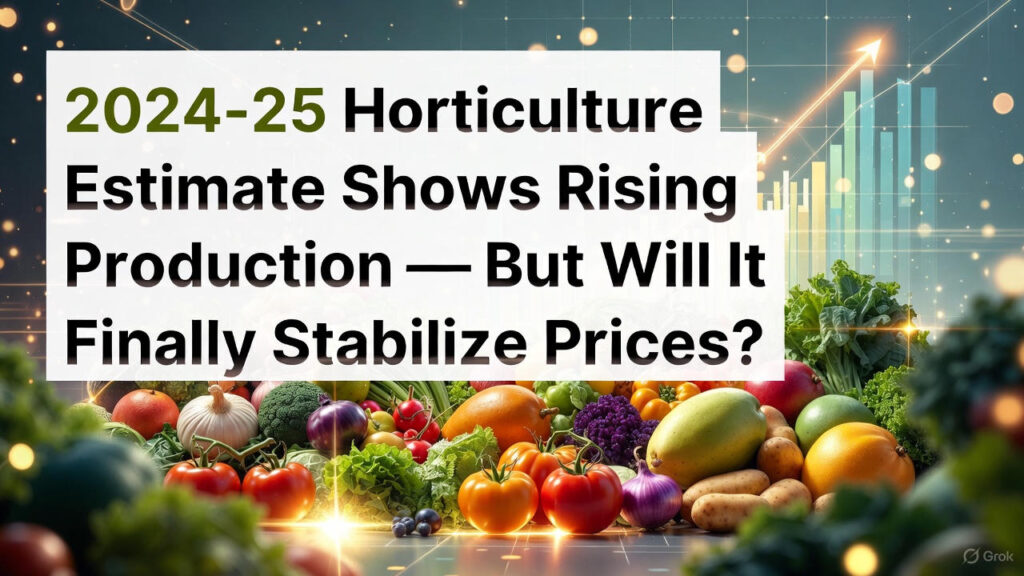
2024-25 Horticulture Estimate Signals Supply Growth — But Real Stability Needs Market Reform
India’s 2024-25 horticulture estimate offers a cautiously optimistic picture. The government’s third advance estimate shows an expansion in horticulture area to 29.488 million hectares and a total output projection of 369.055 million tonnes — an increase of 14.31 million tonnes from last year.
Fruit output is expected to reach 118.76 million tonnes (up 5.12%), vegetables 215.684 million tonnes (up 4.09%), onions 30.789 million tonnes (up 26.9%), potatoes 58.108 million tonnes (up 1.85%), spices 12.503 million tonnes, and medicinal-aromatic crops 0.781 million tonnes.
The numbers are encouraging. Yet, history reminds us that higher production alone does not guarantee lower retail prices. Without structural reforms, India risks repeating the old cycle: bumper harvests on paper, volatile prices in the market, and household budgets under pressure.
Why the 2024-25 Horticulture Estimate Is Not Enough
1. Post-Harvest Losses and Cold Chain Gaps
A significant portion of fruits and vegetables never reach consumers due to gaps in cold storage, poor packaging, and inefficient transport. Without reducing these losses, higher production only creates more waste—not lower prices.
2. Regional and Seasonal Concentration
Output is heavily clustered in certain regions and arrives in markets within narrow time windows. A local climatic shock or a mismatch in arrival timing can cause sudden retail spikes even when annual production is high.
3. Weak Market Linkages and Information Gaps
Small farmers operate with limited aggregation, fragmented markets, and opaque price signals. As a result, surplus at the farm gate doesn’t easily translate into stable prices for consumers.
4. Policy Volatility
Frequent export bans, panic procurement, and sudden tax changes can disturb markets rather than stabilizing them.
What Must Be Done: Immediate, Medium-Term & Structural Actions
Immediate Steps (0–6 Months)
• Real-Time Arrival Monitoring
Daily mandi arrival data for onions, tomatoes, and potatoes should be published on a centralized dashboard to guide buyers, processors, and procurement agencies.
• Targeted Storage Support
Short-term subsidies for storage, electricity, and transport can prevent distress sales during surplus arrivals and reduce sudden retail price swings.
• Calibrated Trading Measures
Instead of blanket export bans, use targeted, time-bound export permits linked to domestic availability thresholds.
Medium-Term Steps (6–24 Months)
• Expand Cold Chain Beyond Potatoes
Set up plug-and-play cold hubs in key onion, tomato, mango, and jamun clusters using PPP models and viability gap funding.
• Boost Processing Capacity
Build community-level processing units for dehydration, freezing, and canning. Incentivize private processing with tax benefits and grants.
• Strengthen FPOs
Support Farmer Producer Organizations with credit lines, aggregation grants, and digital market linkages so they can negotiate better and reduce volatility.
Structural Reforms (2–5 Years)
• Modernize Market Infrastructure
Upgrade mandis, link them to e-NAM, enforce fast settlement timelines, and promote private full-stack markets that reduce intermediary friction.
• Cut Post-Harvest Losses from 30% to Under 10%
Set national and state targets with measurable action plans for cold chain expansion, packaging improvements, and rural logistics.
• Invest in Climate-Resilient and Storage-Friendly Varieties
Support research on shelf-stable and region-specific horticulture varieties that reduce sudden gluts and shortages.
• Develop Insurance & Futures Contracts
Expand perishable crop insurance and introduce regulated futures contracts for major crops like onions.
• Build a Strategic Stabilization Mechanism
Use a smart buffer system that blends small public stockpiles, private storage incentives, and a rapid-response price stabilization fund.
How to Finance These Reforms
- Redirect a portion of the agriculture budget toward cold-chain and processing infrastructure.
- Tap into green/climate finance for solar-powered cold chains.
- Use outcome-based grants tied to reduced losses and higher farmer incomes.
Political and Consumer Impact
If policymakers act now, the 2024-25 horticulture estimate could become a turning point—leading to stable vegetable and fruit prices and improved farmer earnings. But if reforms stall, India may again face the contradiction of “record production” alongside empty kitchen wallets.
Ground Reality
The 2024-25 horticulture estimate is a promising baseline. Yet, its benefits depend on practical changes in storage, processing, aggregation, and market design. Production growth must be paired with systemic reform — otherwise, these millions of tonnes will remain comforting statistics rather than real relief for consumers and farmers.