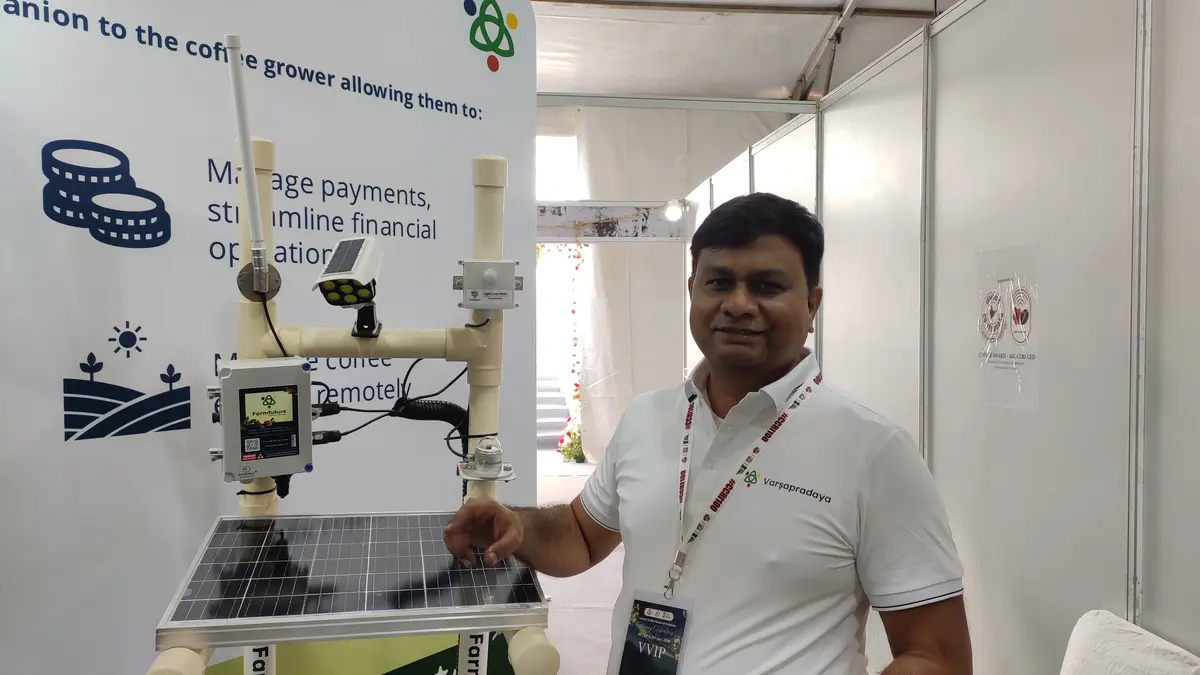
Prem Thudiya, CEO, Varaspradaya with soil nutrient monitoring equipment
Agritech firm Versapradaya is bringing digital intelligence to India’s coffee fields with the launch of its IoT-based automated weather gauge stations and soil nutrient monitoring devices. The company has recently rolled out these solar-powered systems, having completed about 20 installations so far, primarily among individual coffee growers.
With the pace of early adoption increasing, Varsapradaya is setting its sights on a larger scale. “We expect to install around 450-500 devices this year,” said Prem Thudiya, CEO of Versapradaya, indicating the growing demand for technology-led farm management solutions in the coffee sector.
At the core of the offering is a sensor-driven soil nutrient monitoring tool designed to provide real-time insight into plantation health. The system continuously tracks key parameters including moisture and electrical conductivity as well as nitrogen, phosphorus and potassium (NPK) levels. Together, these metrics provide growers with a detailed, data-backed understanding of soil conditions and crop requirements.
Complementing this is the company’s automated weather gauge station, which captures hyperlocal climate data important for plantation management. Varsapradaya’s weather stations cost around ₹65,000, while soil nutrient monitoring devices cost around ₹40,000. A single soil and nutrient tracking unit can effectively cover up to five acres, improving cost efficiency for growers managing fragmented or medium-sized holdings.
Beyond hardware, the company is positioning itself as a consultant-driven solutions provider. Using data generated by installed equipment, VersaPradaya will provide actionable insights to growers through an app, including disease alerts, nutrient deficiency assessments and recommendations for agricultural operations such as irrigation and fertigation.
This data-centric approach is increasingly relevant as coffee growers face increasing agronomic challenges amid changing climate patterns. Irregular rainfall, increasing temperature variability, and changing pest and disease patterns are making traditional decision-making models less reliable. Therefore, accurate monitoring tools are becoming essential risk management tools.
The company uses artificial intelligence, visual language model tools to identify disease and nutrient deficiencies. “Just recently, about two weeks ago, we introduced another tool in the app where a video of the plant will be taken. And it will tell them what the percentage of ripeness of the cherries is. Because it was picking season, we decided this would help them,” Thudiya said, adding that the company will keep adding more features to the app.
The company plans to set up a manufacturing unit in Mysore, where it will assemble the devices. “It will be very convenient for us to handle the market of Karnataka, Kerala and Tamil Nadu from Mysore,” Thudiya said. “Once we are stable here, we will have another facility on the East Coast,” he said.
The company is importing the probe from China, while all the software and layout, assembly is being done in India. He said that the company is in touch with many research institutes.
The company is exploring options to expand the use of these equipment to other plantation crops such as pepper and betel nut, among others.
Published on February 20, 2026