The sound of rain tapping on my balcony roof filled me with anticipation. The aroma of damp neem leaves fills the air. I found six hazelnuts, wrapped in moss, tucked into a yoghurt tub at the back of my fridge.
It’s 31 December 2025, and I’m finally trying to learn how to grow hazelnuts from seed the right way. There will be no more guesswork involved. I will not be planting roasted nuts as I did in 2022—yes, really. I thought “raw” on the label meant alive. It didn’t.
Back then, I followed one YouTube guide that said 60 days of cold was enough. It wasn’t. I wasted a whole season believing that. Nothing sprouted. All I saw was silence and a patch of mould growing in a cracked clay pot.
This time? I’m going full step-by-step hazelnut seed planting, with 100 days of chill, proper drainage, and—critically—two or more seeds, because hazelnut propagation from seed only pays off if you respect pollination. And patience. So much patience.
Warm climates make hazelnuts tricky—but not impossible. If you’ve ever wondered whether you can grow hazelnuts from store-bought nuts or whether hazelnut seed germination even works in Indian humidity, I’ve been there. Failed. Learnt. And now, I’m walking the path again—with better moss, a clearer calendar, and zero roasted nuts.
Can You Grow Hazelnuts from Seed Successfully at Home?

Is Growing Hazelnuts from Seed at Home Worth the Time?
Six to eight years. That’s the real talk. Not “a few seasons”—a proper chunk of your life. But here’s the thing: a tree you grow from seed becomes part of your story. Mine might never yield commercial-grade nuts, but if it gives me even a handful by 2032, I’ll call it a win.
Growing hazelnuts from seed vs. buying nursery trees.
Last year, I almost dropped ₹2,200 on a grafted sapling. Then I spoke to a grower in Coorg who said imported varieties often collapse in our monsoon humidity. Growing hazelnuts from seed lets the tree adapt slowly—roots learning your soil, leaves adjusting to your light. It’s slower, yes, but sturdier.
What to Expect When Growing Hazelnut Trees from Seed
Don’t picture a neat tree right away. Most seedlings start as wild, suckering shrubs. My cousin in Pune spent three years just trying to train one in a single trunk. He kept saying, “It’s like arguing with a teenager.” Honestly? Accurate.
What Kind of Hazelnut Tree Grows from Seed?
Do hazelnut trees grown from seeds grow true to their parents?
Nope. Did you crack open the fancy nut you planted? Its offspring might be smaller, later to fruit, or weirdly shaped. I once grew one from a Turkish batch—beautiful leaves, but the shells were so thick we needed a hammer. The fruit was still edible, but it had a unique character.
Genetic Variation in Hazelnuts Grown from Seed
That variation isn’t always detrimental. In fact, in unpredictable climates like ours, it might be your advantage. One seed could handle heat better. Another might shrug off fungal spots. I’m planting six hazelnut seeds this time, hoping that at least one will become a local mutant that thrives.
The difference between European and American hazelnuts grown from seed is significant.
European types (Corylus avellana) give bigger nuts but demand real winter chill—500 to 1,200 hours below 7°C. American hazelnuts (Corylus americana) are smaller and more resilient and have a scrappier growth habit compared to European varieties. For most of India? Hybrids leaning American are your best shot.
Understanding Hazelnut Seeds Before Planting
What Makes a Hazelnut Seed Viable for Germination
Heavy sinks. That’s my rule. Drop them in water—floaters are hollow or dead. Additionally, they should not have any pinprick holes, as this can indicate the presence of weevils. Last year, I missed one tiny hole. It rotted in the second week, causing a fungal domino effect that affected two of my neighbours’ seeds.
Can You Grow Hazelnuts from Store-Bought Nuts?
You can grow hazelnuts from store-bought nuts occasionally, but usually not. Most “raw” supermarket nuts are steam-pasteurised. This process kills the embryo. I learnt this lesson after wasting ₹150 on a fancy brand. Now, I only buy from seed exchanges or organic grocers who confirm viability.
How Long Do Hazelnut Seeds Remain Viable Before Planting
Room temperature? The seeds disappear within 3–4 months. However, if you refrigerate them in breathable paper, they can last up to a year. Refrigerated in breathable paper, the seeds can last up to a year. I keep mine in a cloth pouch inside a sealed jar—away from onions. (Yes, ethylene from onions can mess with dormancy. (Learnt that from a retired hort teacher in Mysuru.)
How to Prepare Hazelnut Seeds for Germination
Why Cold Stratification Is Required for Hazelnut Seeds
They evolved in temperate forests. Without winter, they won’t wake up. Skipping this routine is like expecting someone to run a marathon without sleep. I did it in 2022. I was unable to produce any sprouts. I learnt my lesson.
How to Cold Stratify Hazelnut Seeds Naturally Outdoors
If you’re in a proper cold zone—Shimla, Darjeeling, Kashmir—just bury them 5 centimetres deep in November under leaf mulch. They’ll get a natural chill and pop up in spring. My uncle in Manali does this every year. 85% success.
Cold stratification of hazelnut seeds should be done in a refrigerator.
What does this mean for the rest of us? Fake it. Damp sphagnum moss, plastic tub with air holes, back of the fridge. I use an old pickle jar—clean, breathable, and out of sight (so I don’t keep checking).
How long should hazelnut seeds be stratified to achieve the best germination results?
The optimal time to stratify hazelnut seeds is between 90 and 120 days. Not 60. Not “a couple of months”. I marked my calendar: start 15 December, plant 15 March. Miss that window, and you’re battling summer heat with fragile roots.
Best Time and Climate to Grow Hazelnuts from Seed
Best Season to Plant Hazelnut Seeds for Germination
The best time to plant hazelnut seeds for germination is from late February to early March, just after the end of winter and before the onset of pre-monsoon heat. I planted one in May. The seedlings were fried by June. Never again.
The temperature and chill requirements for hazelnut seed germination are essential to consider.
They need 500–1,200 chill hours. Hyderabad gives maybe 120. So no—nature won’t do the work for you. Fridge stratification isn’t optional here. It’s the whole game.
Growing Hazelnuts from Seed in Cold Climates.
If you’ve got real winter, you’re golden. Plant stratified seeds in early spring. One gardener in Srinagar told me he tucks them near walnut trees—partial shade, excellent airflow. Simple. Smart.
Can You Grow Hazelnuts from Seed in Warm or Mild Climates?
Yes—but it’s an uphill climb. You’ll need artificial chills, afternoon shade, and vigilance against fungal rot in the monsoon. I’ve got mine planned near my curry leaf plant, with a bamboo screen for summer. Fingers crossed.
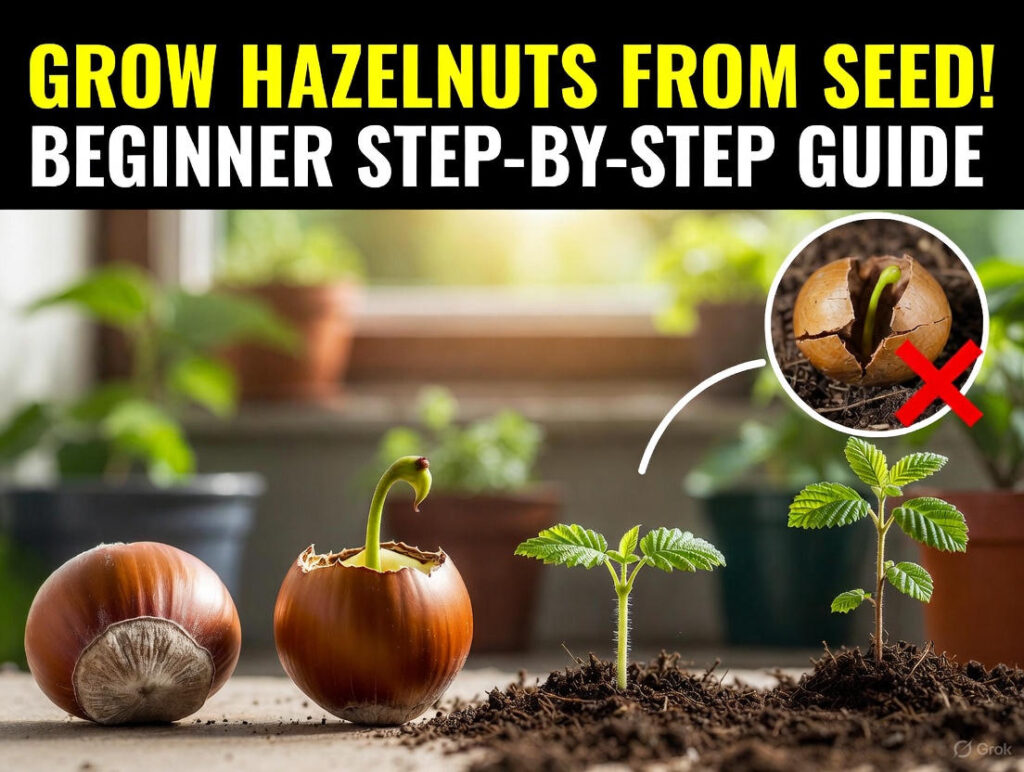
How to Grow Hazelnuts from Seed Step by Step
Step 1 – Selecting Healthy Hazelnut Seeds for Planting.
Select only the heaviest, darkest, and unblemished seeds for planting. Do the float test. Toss anything light. I keep maybe 30% of what I buy.
Step 2 – Stratifying Hazelnut Seeds Correctly.
The seeds should be kept for 90–120 days in a damp but not soggy environment at a temperature of 1–4°C. Verify every two weeks. If mould appears, rinse it with diluted neem water and refresh the moss. Don’t panic—surface mould isn’t always fatal.
Step 3 – Preparing Soil for Hazelnut Seed planting.
Mix: 50% garden soil, 30% compost, 20% coarse sand. Add a handful of crushed charcoal—my neighbour swears it cuts root rot. I’m trying it this season.
Step 4: How Deep Should I Plant Hazelnut Seeds?
5 centimetres. Plant the pointy end down. I use a ruler. Eyeballing leads to shallow planting—and dried-out embryos.
Step 5 – Watering Hazelnut Seeds After Planting
Water gently until moist. Then wait. Don’t water again until the top 2 centimetres feel dry. Overwatering is the silent killer. My first batch drowned because I “loved them too much”.
The best soil and containers for growing hazelnuts from seed
Ideal Soil pH and Drainage for Hazelnut Seedlings
pH 6.0–7.0. If your soil is heavy clay (like mine), mix it with river sand and leaf mould. Drainage must be fast—roots hate sitting in water.
Organic Matter Requirements for Hazelnuts Grown from Seed: Compost is necessary, but it should be aged.
Compost? Yes—but aged. Fresh manure burns young roots. I use six-month-old cow dung compost—it smells earthy, not sour.
Growing Hazelnuts from Seed in Pots or Containers.
Short-term, yes. Use a minimum 15-litre pot—about 30 centimetres wide and deep. After 18 months, move to the ground. Terracotta breathes better than plastic.
| Container Size | Suitable Duration | Notes |
|---|---|---|
| 5-litre pot | Up to 6 months | Risk of stunting |
| 10-litre pot | Up to 12 months | Minimum for healthy roots |
| 15-litre+ pot | 18–24 months | Ideal for balcony trials |
Hazelnut Seed Germination and Early Seedling Care

How Long Do Hazelnut Seeds Take to Germinate
4 to 8 weeks after planting—assuming proper stratification. Don’t dig them up to “check”. You’ll snap the delicate radicle. Patience isn’t optional.
Light Requirements After Hazelnut Seed Germination
Bright, indirect light for the first 3 months. Full sun too soon = scorched leaves. I use a 50% shade net until they’re 30 centimetres tall.
Watering Schedule for Hazelnut Seedlings
Summer: every 2–3 days. Winter: once a week. I always apply water at the base of the plant, never above it. Monsoon? I tilt pots slightly to avoid water pooling.
Common Hazelnut Seed Germination Problems and Solutions
- Mould: Reduce moisture, add neem cake.
- No sprout: This is likely due to insufficient chilling. Extend stratification next time.
- Leggy stems: Not enough light. Move gradually to a brighter spot.
Transplanting Hazelnut Seedlings Grown from Seed

When to Transplant Hazelnut Seedlings Outdoors
Transplant hazelnut seedlings outdoors when they are 12–18 months old and have reached a height of 45–60 centimetres with woody stems. I missed this once—the roots circled, and the tree never thrived.
Proper spacing for hazelnut trees grown from seed should be 4.5 to 6 metres apart.
The recommended spacing for hazelnut trees grown from seed should be between 4.5 and 6 metres apart. Yes, that’s huge—but they spread. I still don’t fully agree on spacing. Some growers swear by tighter planting for wind protection—but for a home garden, wider spacing has worked better for me so far.
Protecting Young Hazelnut Trees from Frost and Pests
In cold zones, wrap trunks with jute in winter. In India, the monsoon brings leaf-eating caterpillars. I spray weekly with garlic-chilli water—cheap, effective, and chemical-free.
Pollination Requirements for Hazelnut Trees Grown from Seed
Do You Need More Than One Hazelnut Tree to Get Nuts
Absolutely. They’re self-incompatible. One tree = zero nuts. Ever. I’m planting all six close together so they can cross-pollinate easily.
How Wind Pollination Works in Hazelnut Trees
There is no need for bees; a breeze suffices. Male catkins shed pollen in late winter; tiny red female flowers catch it. That’s why airflow matters more than flowers.
Hazelnut Tree Spacing for Proper Pollination
Keep them 3–5 metres apart in a home plot. Too far, and pollen won’t travel. Too close, and they compete for light and water.
How Long Does It Take to Grow Hazelnuts from Seed?
Hazelnut Tree Growth Timeline from Seed
- Year 1: Seedling establishes
- Years 2–3: Bushy growth, 1–1.5 metres
- Year 4–5: Maybe first flowers
- Years 6–8: First real harvest
When hazelnut trees grow from seed, they start producing nuts.
Usually, this occurs in the sixth or seventh year. My neighbour’s tree (planted in 2018) finally fruited last August—just 12 nuts. We toasted them like they were gold.
The expected yield from hazelnuts grown from seed is 2 to 5 kilogrammes per mature tree each year.

2–5 kilograms per mature tree per year. Not enough to sell—but plenty for home baking, gifting, or storing in jars like winter treasure.
If you’re curious how a few backyard trees might scale up—or what tricks commercial growers use to get plumper nuts and heavier harvests—I found this no-fluff guide from Agrifarming really helpful: ways to boost hazelnut yield and improve nut quality
Caring for Hazelnut Trees Grown from Seed Long Term
Pruning Hazelnut Trees Grown from Seed
Late winter is best. Remove suckers, crossed branches, and anything growing inward. I aim for an open vase shape—letting light and air through.
Watering and Mulching Hazelnut Trees
Deep water once a week in dry months. Mulch it with dry leaves or wood chips—but keep it 15 centimetres away from the trunk to avoid collar rot.
Natural Fertilizers for Hazelnut Tree Growth
Once a year in early spring: composted cow dung + bone meal. I also bury banana peels near the drip line—potassium boost, zero cost.
Here are some common mistakes to avoid when growing hazelnuts from seed.
Skipping Cold Stratification of Hazelnut Seeds
This is the most common mistake. Without it, you’re just burying snacks. I’ve seen three balcony gardeners quit because of this.
Overwatering Hazelnut Seedlings
Soggy soil = root rot. Let it dry between waterings. I stick my finger in—only water if dry past the first knuckle.
Growing Hazelnuts from Seed in Poorly Drained Soil
Clay soil? Fix it. I mixed in sand and rice husk ash. Now water drains in seconds, not hours.
Ignoring Pollination Requirements for Hazelnut Trees
Planting one tree = beautiful leaves, zero nuts. Always plant in pairs or groups—even if you need to use large containers side by side.
Common Questions About Growing Hazelnuts from Seed
Consider starting with a fresh batch. Can you grow hazelnuts from seed at home successfully?
Yes—if you cold-stratify, use viable seeds, and plant two or more trees.
2. How long do hazelnut seeds take to germinate?
4 to 8 weeks after proper stratification and planting.
3. Can you grow hazelnuts from store-bought nuts?
Rarely. Most are heat-treated. It is preferable to purchase from seed suppliers.
4. Do hazelnut trees grown from seed produce nuts?
Yes—but not true to parent, and only after 6–8 years.
5. How many years does it take to grow hazelnuts from seed?
First nuts usually pop up between year 6 and 8—sometimes sooner if conditions are kind, sometimes later if they’re not.
6. Do hazelnut trees need cross-pollination to bear fruit?
Yes—they won’t set nuts on their own. You need a second tree nearby, and it’s got to be a different variety; otherwise, they just sit there looking pretty but fruitless.
7. Can hazelnuts be grown from seed in pots or containers?
Temporarily, yes—but transplant to ground by year two for healthy growth.
8. Are hazelnut trees grown from seed good for home gardens?
Absolutely—they’re low-maintenance long-term, wildlife-friendly, and deeply satisfying.
Final Thoughts
This isn’t fast gardening. It’s slow trust—between you, a seed, and time. My batch from 30 December 2025 might fail. Or one might surprise me. Either way, I’m learning. And if you’re standing in your own small space, wondering if growing hazelnuts from seed is worth it—my answer hasn’t changed: plant two. Stratify well. Give them room. Perhaps, before the end of the next decade, you’ll be enjoying your own success.