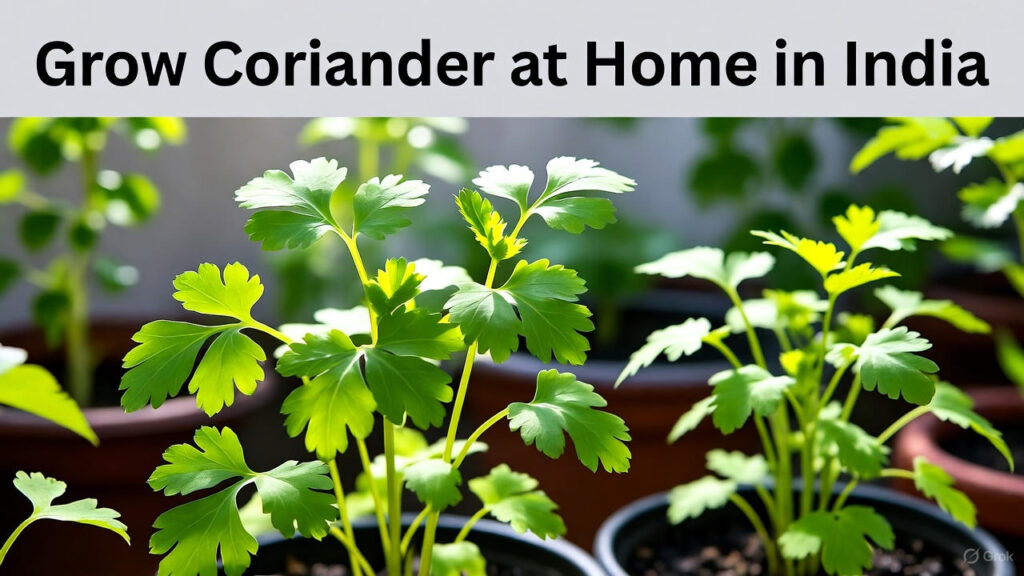
Hey there, fellow herb gardeners! We are back to share a wonderful guide on how to grow coriander at home in India with summer, rainy seasons, and winter gardening tips. If your coriander keeps turning yellow by May, drowning in July’s downpours, or just sitting there with two droopy leaves, you’re not failing—you’re just following advice that doesn’t get India’s quirks. Our scorching sun, sticky monsoons, and subtle roasted seeds from the spice aisle can challenge even the most experienced gardeners.
I’ve killed more dhaniya plants than I care to admit on my tiny 4×6 Chennai balcony. The turning point? Realising coriander isn’t concerned about fancy gardening books. It cares about your balcony’s sun angle, your tap water, the monsoon humidity, and whether your seeds were meant for planting or tossed into a masala mix. This guide isn’t a generic, copy-paste guide. It’s real talk from someone who’s been there, figured it out, and now grows lush coriander in old rice sacks and cracked buckets. Let’s get your dhaniya thriving, whether you’re in a cramped Mumbai flat or a sunny Delhi terrace.
Why Your Coriander Fails (And How to Fix It)

Coriander isn’t fussy—it just hates extremes. I’ve messed up plenty of times, and most failures come down to a few rookie mistakes. Here’s what I see new gardeners across India doing wrong and how to dodge those traps.
Top 5 Coriander Killers
- Overwatering in monsoon: Soggy soil drowns roots. Please check 2 inches deep—if it’s wet, kindly hold off. Mumbai’s rains are brutal.
- Using spice-jar seeds: Supermarket coriander seeds are roasted or irradiated. Buy raw, plump seeds from a sabzi mandi.
- Ignoring summer shade: above 35°C, coriander bolts fast. Move to morning sun only, or it’s done by May.
- Cramming seeds too close: Sow 8 cm apart, or they’ll choke each other. I did this in Bengaluru once—zero leaves.
- Skipping drainage: no holes, no harvest. Punch 8-10 holes in every pot, even the “fancy” ones.
If you address these issues, your coriander plants will have a better chance of thriving. Avoiding these mistakes turned my last batch into a green masterpiece.
How to Test if Coriander Seeds Will Sprout (Before You Waste Time)

Don’t waste 10 days on dud seeds. Here’s a 2-minute test to save you the heartache:
- Grab 10 coriander seeds.
- Drop them into a small bowl of room-temperature water.
- Wait 15 minutes. Good seeds sink—they’re plump and full of life. Dead or roasted seeds float—they’re hollow or heat-treated.
If 7 or more sink, you’re golden. If most float, toss them and buy fresh from a sabzi mandi, not the spice aisle. In Pune, farmers call the procedure the ‘uddi wali dhaniya’ test—floating seeds are useless. I now perform this every time, and it has proven to be a significant improvement.
Where to Buy Seeds That Actually Sprout
Skip supermarket spice jars—they’re roasted or irradiated for tadka, not planting. Head to your local sabzi mandi or nursery. In Delhi, Azadpur Mandi has raw, farm-fresh seeds for ₹20-30/100g. In Hyderabad, Moosapet market sells them for ₹25/100g. Look for plump, whole seeds, not dusty or broken ones.
Best Coriander Varieties for Indian Conditions
Ask for ‘Slow-Bolt’ or ‘Sukkha Dhaniya’ seeds. In Maharashtra, ‘Co-1’ or ‘CS-27’ (ICAR-released) give more leaves and resist bolting. Check Krishi Vigyan Kendra (KVK) nurseries. Avoid “imported cilantro”—it’s bred for cold climates and bolts in 10 days here.
For reliable results, try university-developed varieties like TNAU’s Co.1 or Co.3, bred for Indian climates and resistant to common diseases like wilt and grain mould.
If you want a high-yielding, disease-resistant option that works across North and Central India, try Ajmer Coriander 2 (ACr-2)—a variety officially released in 2019 for states like Rajasthan, UP, and Gujarat.
Pick the Right Pot and Soil, Season by Season

Coriander’s got a long taproot, so depth matters more than width. Use containers that are at least 20 cm deep, such as old paint cans that have been washed, 5-litre oil tins, or cracked buckets. Punch 8-10 holes in the bottom for drainage.
For summer, go with terracotta pots; they breathe better in the heat. In winter, plastic pots are fine since they hold moisture longer. Forget pricey potting mixes—they’re often too acidic (pH 4-5) for coriander, which loves a pH of 6.2-6.8. Make your own mix:
| Season | Soil Mix Parts |
|---|---|
| Summer | 4 soil + 4 coco peat + 2 compost |
| Monsoon | 3 soil + 5 coco peat + 2 sand |
| Winter | 5 soil + 3 compost + 2 coco peat |
Toss in a handful of crushed eggshells or bone meal to prevent black leaf tips from calcium deficiency. Do you have old tins lying around? They’re perfect.
You don’t need a big budget to grow lush dhaniya. I’ve been growing coriander using items I found around my Chennai flat or purchased inexpensively from local shops. These tools significantly simplify gardening for city dwellers.
Must-Have Tools (All Under ₹200)
- ₹20 thermometer: Checks your balcony’s temp. If it’s 32°C+ at noon, hold off sowing until cooler days.
- 5L oil tin (free): Wash it, punch 8 holes, and you’ve got a deep pot for coriander’s taproot.
- Neem oil (₹100-200): Get pure neem from a nursery—online stuff is often diluted. Mixes into sprays fast.
- Hand trowel (₹50): Makes soil mixing a breeze without wrecking your hands. Snagged mine at a Delhi kirana store.
- Plastic spray bottle (₹30): Perfect for neem or chilli sprays. This is significantly more effective than sprinkling with a cup.
Hit up local markets—they’re cheaper than online. My cousin in Pune scored a trowel for ₹40 at a roadside stall.
Tool Breakdown
| Tool | Cost | Why It Helps |
|---|---|---|
| Thermometer | ₹20 | Avoids sowing in extreme heat |
| Oil tin | Free | Deep, cheap pot with holes |
| Neem oil | ₹100-200 | Fights pests naturally |
| Hand trowel | ₹50 | Easy soil mixing |
| Spray bottle | ₹30 | Precise pest spray application |
When to Sow Coriander in Your City
Coriander reads the weather, not your calendar. Here’s when to sow, depending on where you are:
- North India (Delhi, Punjab, UP): Mid-September to late February. Skip March to June; the heat makes it bolt fast.
- South India (Chennai, Bengaluru, Hyderabad): Two windows—August to October (post-monsoon) and December to March. Avoid April-May; it’s too hot.
- Coastal (Mumbai, Kochi, Kolkata): Humidity’s the enemy. Stick to November–February and use coconut coir instead of soil to fight mould. Empty the water trays within 30 minutes.
Every balcony’s got its own microclimate, so keep a small diary to track sowing dates and harvest weight.
City Sowing Guide
| City | Sow Months |
|---|---|
| Delhi | Up to mid-Feb |
| Bengaluru | Aug-Oct, Dec-Feb |
| Chennai | Nov-Jan |
| Mumbai | Nov-Feb |
| Kolkata | Oct-Mar (dry months) |
How to Keep Coriander Happy When It’s 40°C Outside

Coriander and Indian summers are like oil and water. Once it hits 35°C, your plant bolts, shooting up a skinny flower stalk and ending your leaf harvest.
You can outsmart the heat, though. In Delhi or Hyderabad, move pots to a spot with sun only until 10 a.m., then full shade. My friend Neeraja in East Delhi drapes an old cotton dupatta over her grow bags during peak afternoon heat—it cools the soil without choking roots.
Use terracotta pots; they let soil breathe. Mix 50% garden earth, 30% coco peat, and 20% well-rotted cow dung. Skip chemical NPK fertilisers—they’re too harsh. Sprinkle two pinches of wood ash per pot weekly for gentle potassium, no burn.
Water only in the early morning, just enough to dampen the top inch of soil. If leaves curl or turn pale green, your plant’s overheating. Snip off the outer third of leaves, move to deeper shade, and skip watering for 24 hours. It’ll bounce back. I tried this last April in Chennai, and it saved my patch when everything else fried.
Quick Summer Soil Mix
- 50% garden earth
- 30% coco peat
- 20% cow dung
Monsoon = Moisture Trap (Here’s How to Outsmart It)
Monsoon feels like coriander’s best friend with that cool, rainy vibe, but it’s a trap—wet feet are its worst enemy. In Mumbai or Bengaluru, one heavy shower can flood your balcony, and within 48 hours, your stems are black and slimy.
In 2023, my friend Ramya in Pune experienced this harsh reality firsthand. Now, she elevates every pot on bricks and drills extra drainage holes, even in “drainage-ready” containers. She also adds a 1-inch layer of broken pottery or gravel at the bottom before soil.
Ditch pure garden soil in rains—it compacts and suffocates roots. Use 60% coco peat, 20% compost, and 20% coarse sand. Only water the top two inches of soil if it feels dry. Monsoon air is so humid, your plants might not need extra water.
See white fuzz or yellow spots? That’s fungal rot. Whip up this simple neem spray:
- 1 litre water
- 5 ml pure neem oil (about 1 tsp)
- 2 ml liquid hand soap (like dish soap)
Shake well, spray early morning, and hit leaf undersides. Keep pots 30 cm apart for air circulation. Elevation’s key—I stack bricks under my pots, and it’s a total game-changer.
Monsoon Drainage Steps
- Elevate pots on bricks
- Add a 1-inch gravel layer
- Drill extra holes
- Space pots 30 cm apart
Monsoon Soil Mix
- 60% coco peat
- 20% compost
- 20% coarse sand
You may also check this: How to Make Potting Soil Mix.
Winter: Your Golden Window for Lush Dhaniya
From October to February, Coriander throws a party. Cool days, mild nights, and steady sun mean thick, bushy growth that makes you feel like a pro. My neighbour Divyya in Ludhiana sows a new batch every 20 days, from November to January, and by mid-December, he’s handing out bunches to half the colony. His secret? Rice sacks cut to 30 cm, lined with newspaper, and filled with compost-rich soil. They hold moisture without drowning roots.
Sow seeds half a centimetre deep, 8 cm apart. Water every 2-3 days—winter soil dries slowly. Ensure at least 5 hours of direct sunlight, even if it’s just a south-facing windowsill. Fertilise once, two weeks after sprouting, with poultry manure tea (soak 100 g in 2 L water for 48 hours, strain, dilute 1:1 with water). More than that, and you’ll get weak, leggy stems.
Winter’s when my balcony turns into a dhaniya jungle. You will too.
Winter Fertilizer Recipe
- Soak 100g poultry manure in 2L water for 48 hours
- Strain it
- Dilute 1:1 with water
- Apply once, 2 weeks after sprouting
How Often to Water Coriander by Season
Watering is the most challenging aspect—I’ve successfully drowned numerous pots before mastering the art. If you water it too much, it will become slimy; if you water it too little, it will become crispy. Seasons change the rules, so here’s how to nail it.
Seasonal Watering Guide
| Season | Watering Frequency | How to Check |
|---|---|---|
| Summer | Daily, early morning | Top 1 inch dry |
| Monsoon | Only if top 2 inches dry | Finger test: avoid soggy soil |
| Winter | Every 2-3 days | Top 2 inches dry |
Stick your finger in the soil—it’s the best way to know. In monsoon, the air’s so damp you might skip watering for days. Every evening, my Bengaluru friend inspects her pots, ensuring her plants remain free from rot.
Growing Coriander Indoors in Indian Apartments
No balcony? No sweat. I’ve grown coriander on my Chennai kitchen windowsill, and it’s totally doable, even in a tiny flat. You just need the right setup.
Indoor Coriander Tips
- Find a sunny spot: South-facing windowsills get 5+ hours of sun, perfect for coriander. North-facing? You can get a ₹200 to ₹500 LED grow light from your local nursery or garden store.
- Pick the right pot: Use a 20 cm deep plastic pot—indoor air holds moisture better.
- Soil mix: 50% coco peat, 30% compost, 20% sand. It ensures efficient drainage and effectively combats indoor humidity.
- Water carefully: Check the top 2 inches before watering. Apartments trap moisture, so go easy.
- Prevent mould: Run a small fan if it’s stuffy. My cousin in Bengaluru swears by this for her 1BHK.
I use a recycled curd container, and it’s pumping out leaves like crazy. Rotate the pot every few days for even light.
Indoor Needs and Solutions
| Need | Solution |
|---|---|
| Sunlight | South window or LED grow light |
| Pot | 20 cm deep plastic |
| Soil | 50% coco peat, 30% compost, 20% sand |
| Ventilation | Small fan to prevent mould |
Companion Planting for Healthier Coriander
Coriander is like a friend who thrives when surrounded by the right plants. Pair it with the right plants, and your balcony garden will hum. I’ve tested this remedy on my Chennai setup, and it’s made my dhaniya stronger.
What to Grow (and Not Grow) with Coriander
- Garlic: Plant cloves around the pot’s edge. The smell repels aphids and whiteflies. My Hyderabad neighbour calls it her pest shield.
- Marigolds: Their scent confuses pests. Plus, they make your balcony look festive.
- Mint: Loves similar soil and deters bugs. Keep it in its own pot—mint spreads fast.
- Spinach: Grows happily alongside coriander in cool months without stealing nutrients.
- Avoid fennel or dill: they compete for nutrients, stunting your coriander.
Space companions 20 cm apart to avoid crowding. I learnt the hard way—too close, and it’s chaos.
Companion Planting Benefits
| Plant | Benefit | Tip |
|---|---|---|
| Garlic | Repels aphids, whiteflies | Plant at pot’s edge |
| Marigolds | Confuses pests | Use 1-2 plants nearby |
| Mint | Deters bugs | Keep in separate pot |
| Spinach | Compatible growth | Sow in winter |
More Organic Ways to Keep Pests Off Your Coriander
Neem spray’s a rockstar, but your kitchen’s hiding other pest-fighting gems. I’ve tried these on my balcony, and they’re cheap, natural ways to keep bugs off your dhaniya.
Kitchen-Based Pest Control
- Chilli-Garlic Spray: Blend 2 red chillies and 4 garlic cloves with 1 L of water. Strain and spray weekly. Aphids and whiteflies hate it. My Mumbai neighbour saved her patch with this last July.
- Onion Peel Tea: Steep peels from 2 onions in 1 L warm water for 6 hours. Spray on leaves—pests can’t stand the smell.
- Tobacco Dust: Sprinkle a pinch around stems (not soil). It effectively stops slugs in humid cities, such as Kolkata. Use sparingly—it’s potent.
Apply early morning for best results. I alternate neem and chilli spray to keep pests guessing.
Pest Control Steps
- Pick one: chilli-garlic, onion peel, or tobacco.
- Prep and strain (except tobacco dust).
- Spray or sprinkle early morning.
- Repeat weekly, or after heavy rain.
Fix Common City Problems with Household Stuff
No space? Cut the top off a 2-litre plastic bottle, invert it into the base, add soil, and sow 5-6 seeds. Hang it from your railing—instant planter.
Leggy, pale plants? That’s a sun shortage. Even in winter, north-facing balconies can be too dim. Place a small mirror opposite your pot to bounce light back. Yellow leaves? Probably overwatering. Stick your finger 2 cm into the soil; if it’s wet, wait a couple of days. If drainage is inadequate, mix in sand.
Don’t sleep on rice-washing water. That cloudy stuff from rinsing rice is like a magic potion—pour it on once a week for a leaf boost.
Household Fixes
- No space: Hanging bottle planters (5-6 seeds)
- Leggy plants: Mirror for reflected light
- Yellow leaves: Check 2 cm down with finger, add sand
Why Coriander Fails in Apartments (And How to Prevent It)
High-rise balconies have hidden traps: heat bouncing off walls, AC exhaust drying soil, or west-facing spots that cook plants by noon. Grab a ₹20 thermometer—if your balcony hits 32°C+ at noon in April, wait for winter. Place pots on wooden planks, not hot concrete, to keep roots cool.
What’s Wrong With My Coriander? Fix It by Symptom
Don’t guess—match the problem to the fix:
| Symptom | Fix |
|---|---|
| Leaves turning yellow | Overwatering. Stop 2 days, add sand |
| Leaves curling inward | Heat stress. Shade, morning water only |
| Black tips on leaves | Calcium lack. Add crushed eggshells |
| Tiny green bugs | Aphids. Neem + soap spray |
| Tall, sparse growth | Low sun. 5+ hours direct light |
| Stem rotting at base | Fungus. Elevate, neem every 4 days |
Identify the issue early and address it promptly.
Can You Save a Dying Coriander Plant?
If leaves are yellow but stems are firm:
- Stop watering for 3 days.
- Move to dappled shade.
- Water the plant with 1 litre of water mixed with 1 crushed aspirin, which helps reduce plant stress.
- After two days, feed weak compost tea.
If the stems are black or smelly, they should be discarded. Toss it and sterilise the pot with 1:10 bleach water before reusing. The aspirin trick saved my batch last monsoon—felt like magic.
Harvest Without Killing the Plant

Avoid tearing leaves, as it could lead to the plant’s demise. Use clean scissors or your thumbnail to snip stems just above the lowest leaf joint; that’s where new shoots grow. Take only one-third of the plant at a time. In winter, harvest every 10 days; in summer, you might get one cut before it bolts.
After 3-4 harvests, the plant tires. Pull it out and resow—fresh seeds sprout faster than nursing an exhausted plant. Snip smartly, and it keeps giving.
Harvest Rules
- Cut above lowest leaf joint
- Take only 1/3 at a time
- Winter: Every 10 days
- Resow after 3-4 harvests
10 Kitchen-to-Balcony Hacks for Healthier Dhaniya
- Soak seeds in buttermilk overnight—sprouts 2 days faster.
- Spray onion peel tea (steep peels in warm water for 6 hrs)—deters aphids.
- Place a copper coin at the pot’s base—Tamil Nadu gardeners swear it cuts fungus.
- Grow near marigolds or garlic—confuses pests like whiteflies.
- Scatter crushed eggshells around stems—stops slugs in humid cities.
- Water the plants with rice-washing water once a week to provide a natural leaf booster.
- In winter, line pot bottoms with old newspaper—gentle root warmth.
- After monsoon rain, dust wood ash—balances pH, adds potassium.
- Tie floppy stems with clean cotton thread—prevents breakage.
- Rotate pots every 3 days—ensures even sun on narrow balconies.
These tricks are why my Dhaniya is thriving.
You may also like this: How to Grow Coriander on a Terrace.
6 Real Questions Indian Gardeners Ask
1. Why does my coriander turn yellow?
Is it due to overwatering or poor drainage? Check 2 cm deep—if wet, wait 2 days. Add sand, ensure 8-10 drainage holes, and shade in summer. This method helped me save my batch.
2. How do I stop coriander from bolting in the summer?
Heat above 35°C triggers bolting. Sow in cool months (Nov-Feb). In the summer, give the morning sun only, shade later, and cover with a dupatta. Water lightly.
3. Where do I buy coriander seeds that sprout?
Skip supermarket spice jars—they’re roasted. Purchase raw seeds from a sabzi mandi (e.g., ₹20-30/100g at Delhi’s Azadpur Mandi). Test: successful seeds sink in water.
4. How often should I water coriander?
Summer: daily, morning, top inch damp. Monsoon: only if the top 2 inches are dry. Winter: every 2-3 days. Finger-test soil to avoid overwatering.
5. How do I keep pests off coriander naturally?
Use neem spray (1 L water, 5 ml neem oil, 2 ml dish soap) weekly. Or try chili-garlic spray (2 chillies, 4 garlic cloves, 1 L water). Spray mornings.
6. Can I grow coriander indoors in an apartment?
Yes! Use a 20 cm deep plastic pot with 50% coco peat, 30% compost, and 20% sand. Place on a south-facing windowsill or use a ₹200 LED grow light. Water sparingly.
These are the questions I hear most. Bet you’ve wondered a few yourself.
In case you missed this: How to Start Coriander Seeds in Hydroponics.
Grow Coriander with Kids—It’s Fast and Fun
Coriander sprouts in 5-7 days, perfect for little gardeners. Let them:
- Decorate a plastic bottle planter.
- Poke drainage holes.
- Sow seeds.
- Mark growth with painted sticks (“Day 1”, “First Green!”).
They’ll love snipping leaves for dinner and might even try the chutney. My niece in Chennai is obsessed with “her” dhaniya pot.
Final Takeaway: Work With the Season, Not Against It
Coriander’s not picky—it just hates extremes. Protect it during the summer, drain it during the monsoon, and harvest abundantly during the winter months. Use what you’ve got—old tins, rice sacks, even that cloudy rice-washing water. Sow small batches every 3 weeks in cool months; skip peak heat.
Do this, and you’ll be tossing fresh dhaniya into your dal or handing bunches to neighbours without asking, “Why did mine die again?” Stick with it, and you’ll have buckets of green goodness. Trust me, there’s nothing like the smell of homegrown coriander in your kitchen.