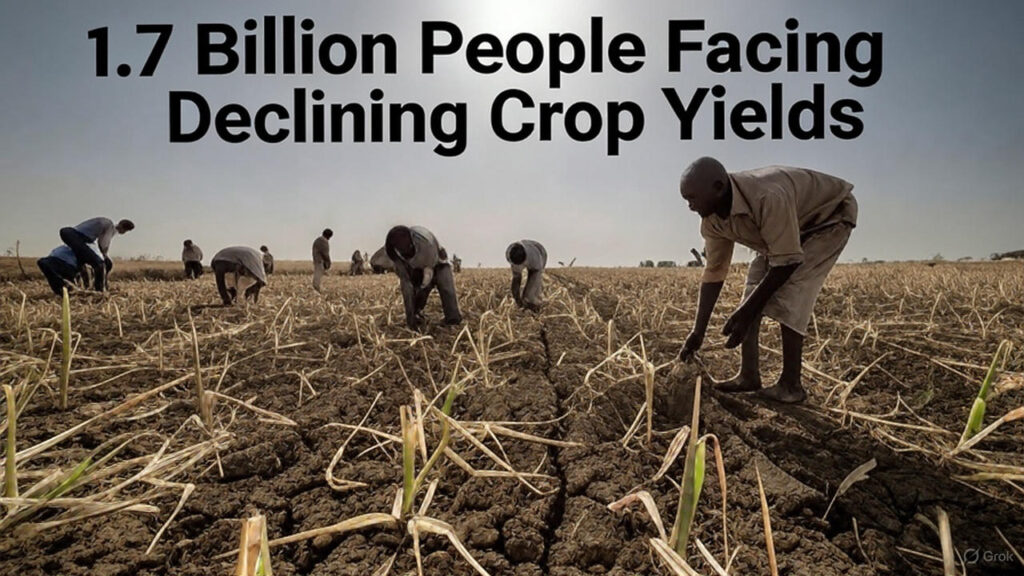
The State of Food and Agriculture (SOFA) 2025 report estimates that approximately 1.7 billion people worldwide live in areas where crop yields are 10 percent lower due to human-induced land degradation. Of these, 4.7 crore are children below 5 years of age who are suffering from dwarfism.
A staggering 1.7 billion people around the world are living in areas where agricultural productivity is declining due to human-caused land degradation, according to a new report released today. Food and Agriculture Organization (FAO).
State of Food and Agriculture (SOFA) 2025 Land degradation described in report unveiled at FAO headquarters in Rome “Widespread and silent crisis” Which is reducing farming productivity and endangering the health of ecosystems around the world.
The report estimates that crop production in the affected areas has reduced due to land degradation. 10 percent Less due to human-induced land degradation. Of the 1.7 billion affected population, 47 million are children under five years of age who suffer from stunting and malnutrition.
A crisis beyond the environment
The report makes clear that land degradation extends far beyond environmental concerns, with direct impacts on agricultural production, rural livelihoods and the food security of billions of people.
Asian countries Due to both cumulative decline and high population density, populations suffer the most severe impacts in absolute numbers. This report represents the most comprehensive analysis to date examining how human-induced land degradation affects crop yields globally.
understanding the problem
FAO defines land degradation as the long-term decline in the ability of land to provide essential ecosystem functions and services. This phenomenon typically results from multiple factors, including natural processes such as soil erosion and salinization combined with rapidly increasing human pressure.
The report uses a credit-based approach to measure declines, comparing current conditions of soil organic carbon, soil erosion and soil water to those that would exist without human intervention. A machine-learning model integrates environmental and socio-economic factors to predict baseline conditions.
a way forward
Despite the grim statistics, SOFA 2025 presents an optimistic view: reversing just 10 percent of the human-induced decline on existing cropland could restore enough agricultural production to feed an additional 154 million people annually.
Such restoration can be achieved through sustainable land management practices including crop rotation, cover crops to preserve soil health, erosion reduction measures, and biodiversity conservation efforts.
The report outlines actionable opportunities for adapted policies as well as integrated sustainable land-use and management practices. These measures aim to prevent, reduce and reverse land degradation while improving food production and farmers’ livelihoods.
“To take advantage of these opportunities, we must act decisively. Sustainable land management requires an enabling environment that supports long-term investment, innovation and management,” said FAO Director-General q dongyu Wrote in the introduction of the report.
analog solution
The report emphasizes that although land degradation affects farms of all sizes, policy interventions should be tailored to address specific farming structures. Small farmers face different financial constraints than larger operations, which manage the majority of agricultural land and have greater ability to implement solutions at scale.
SOFA 2025 calls for integrated land-use strategies and policy interventions – including regulatory measures such as controls on deforestation, incentive-based programs and cross-compliance mechanisms that link subsidies to environmental outcomes.