Sugar Release Quota 2025-26 Cut Despite Higher Production Estimates
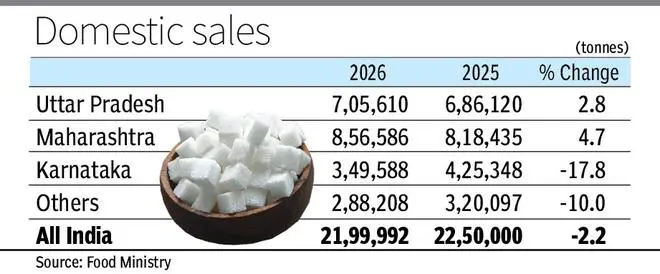
The Sugar Release Quota 2025-26 for the first four months of the season (October to January) has been fixed at 88 lakh tonnes, which is 4.3 per cent lower than the same period last year. For January alone, the Indian government has allowed sugar mills to sell 22 lakh tonnes in the domestic market, a decline of 2.2 per cent compared to 22.5 lakh tonnes a year ago.
This reduction comes even as sugar production estimates for the 2025-26 season (October–September) remain higher, posing fresh challenges for sugar market management.
Domestic Sugar Sales Decline Amid Weak Demand
According to trade sources, domestic sugar sales have weakened this season due to lower consumer demand. Actual sales during October–November were nearly 50,000 tonnes lower than expected. This has complicated the implementation of the Sugar Release Quota 2025-26, especially as surplus production pressures continue to build.
Industry representatives have already raised concerns that restricted domestic sales could delay sugarcane payments to farmers.
State-Wise Impact of Sugar Release Quota 2025-26
Mill-wise quota allocation shows a sharp reduction for Karnataka. Sugar factories in the state have been allowed to sell 3.49 lakh tonnes in January, down nearly 18 per cent from 4.25 lakh tonnes last year.
In contrast, Uttar Pradesh and Maharashtra — the country’s two largest sugar-producing states — have received higher domestic sales quotas:
- Uttar Pradesh: 7.06 lakh tonnes, up 2.8% year-on-year
- Maharashtra: 8.57 lakh tonnes, up 4.7% year-on-year
Experts clarified that Karnataka’s lower allocation under the Sugar Release Quota 2025-26 is not linked to farmer protests, as the quota formula remains uniform across states.
Export Quota Swapping Alters State Allocations
An important factor influencing allocations this year has been the export quota swap mechanism. Under this system, sugar mills are permitted to exchange domestic sales quota with export quota, provided the overall national quota remains unchanged.
For instance, Godavari Biorefineries’ Sameerwadi sugar factory in Karnataka surrendered over 12,000 tonnes of its domestic quota in exchange for export quota from mills in other states. As a result, its export allocation has been revised to 35,449 tonnes.
Several cooperative mills in Maharashtra have also increased export quotas using this mechanism. However, government rules ensure that no single mill can expand its export quota unilaterally by surrendering its entire domestic allocation.
Reduced Ethanol Diversion Boosts Sugar Output
India’s gross sugar production for the 2025-26 season is estimated at around 343 lakh tonnes, compared to under 300 lakh tonnes in 2024-25. While the export quota has increased to 15 lakh tonnes from 10 lakh tonnes last year, ethanol diversion has been reduced.
The ethanol quota has been cut to 29 lakh tonnes from 35 lakh tonnes previously. Since producing ethanol from C-heavy molasses is more profitable than using sugarcane juice, mills are now diverting less cane for ethanol and producing more sugar instead. This has directly influenced the Sugar Release Quota 2025-26 dynamics.
Sugar Production Rises Sharply in Key States
According to the National Federation of Cooperative Sugar Factories Ltd (NFCSF), sugar production during October–December 2025 stood at 118.3 lakh tonnes, registering a 24 per cent increase over 95.6 lakh tonnes recorded a year earlier.
However, states such as Bihar, Haryana, Madhya Pradesh, Telangana, and Tamil Nadu have reported lower output.
State-wise production figures so far are:
- Maharashtra: 48.70 lakh tonnes
- Uttar Pradesh: 35.65 lakh tonnes
- Karnataka: 22.10 lakh tonnes
Together, these three states account for nearly 90 per cent of India’s total sugar production this season.
Outlook for Sugar Release Quota 2025-26
While higher production offers export opportunities, reduced domestic quotas and lower ethanol diversion could pressure mill cash flows and farmer payments. The evolving Sugar Release Quota 2025-26 policy will remain critical in balancing surplus management, farmer interests, and price stability in the coming months.