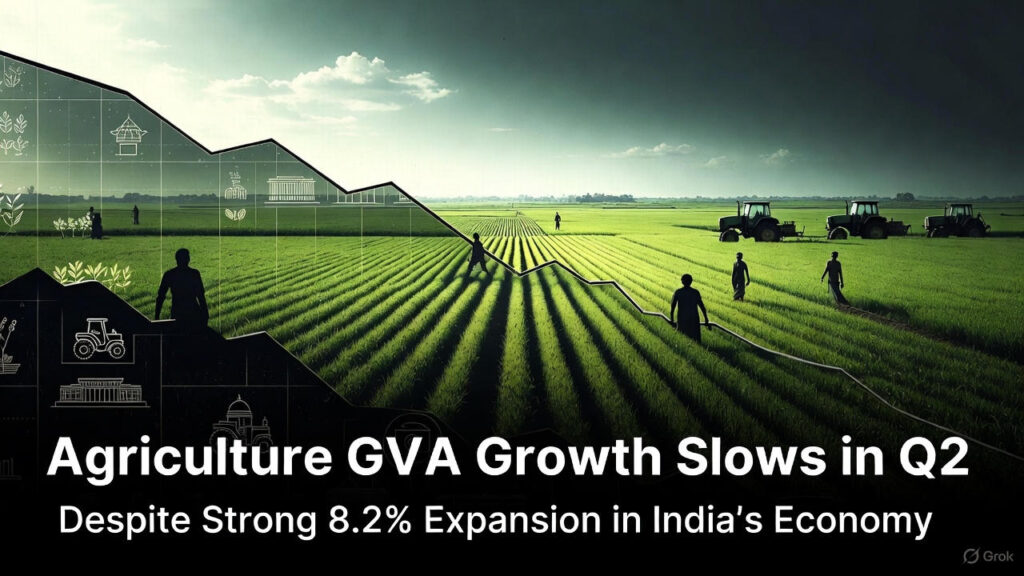
Agriculture GVA Growth Weakens Even as India Posts Strong Q2 GDP Numbers
India’s economy delivered an impressive 8.2% GDP growth in the July–September quarter, but the momentum remains uneven. The latest National Statistics Office (NSO) data reveals that Agriculture GVA Growth is now the slowest segment of the economy, signaling deeper structural challenges in the rural sector.
Q2 Agriculture GVA Growth Lags Behind Industry and Services
Real Gross Value Added in agriculture rose from ₹4.76 lakh crore to ₹4.93 lakh crore in the second quarter. However, this modest increase stands in sharp contrast to the overall 8.1% GVA expansion.
- Manufacturing surged by 9.1%
- Services grew by 9.2%
- Agriculture & allied sectors expanded only 3.5%
The subdued Agriculture GVA Growth reflects the impact of an uneven monsoon, weak price realization and a 4.9% drop in WPI food index, which pushed farmer margins further down.
Meanwhile, mining contracted slightly at -0.04%, further pulling down primary sector performance.
Low Farm-Gate Prices Strain Rural Demand
The softness in agriculture is already echoing through rural markets.
Private Final Consumption Expenditure (PFCE) grew 7.9% in Q2, but most of the boost came from urban, higher-income households. Rural consumption remains under pressure due to:
- shrinking farmer margins
- rising input costs
- weak returns on key crops like rice (2.9% growth)
Farmers, who form the backbone of India’s consumption engine, are seeing limited benefits from broader economic growth.
Primary Sector Trails as Agriculture GVA Growth Stays Low
Half-year numbers paint the same picture:
- Primary sector growth: 3.6%
- Secondary sector growth: 7.6%
- Services growth: 9.3%
- Agriculture (first half): just 2.5% — the lowest among all major sectors
Adding to this slowdown, Government Final Consumption Expenditure (GFCE) fell by 2.7% in Q2, offering minimal fiscal cushion for rural households.
Structural Risk: Agriculture GVA Growth Becomes the Economy’s Weak Link
While GDP reached ₹48.63 lakh crore in Q2 and half-year growth stood at a robust 8%, the underlying stress in agriculture cannot be ignored.
With nearly half of India’s workforce depending on farming, low Agriculture GVA Growth risks:
- reducing rural consumption
- increasing pressure on agricultural credit
- complicating food inflation management
- widening income gaps between urban and rural India
As India prepares to transition to a new GDP base year (2022–23), statistical adjustments are expected. However, the core message remains unmistakable: India’s growth story is strong, but the slowdown in agriculture is emerging as its biggest structural vulnerability.