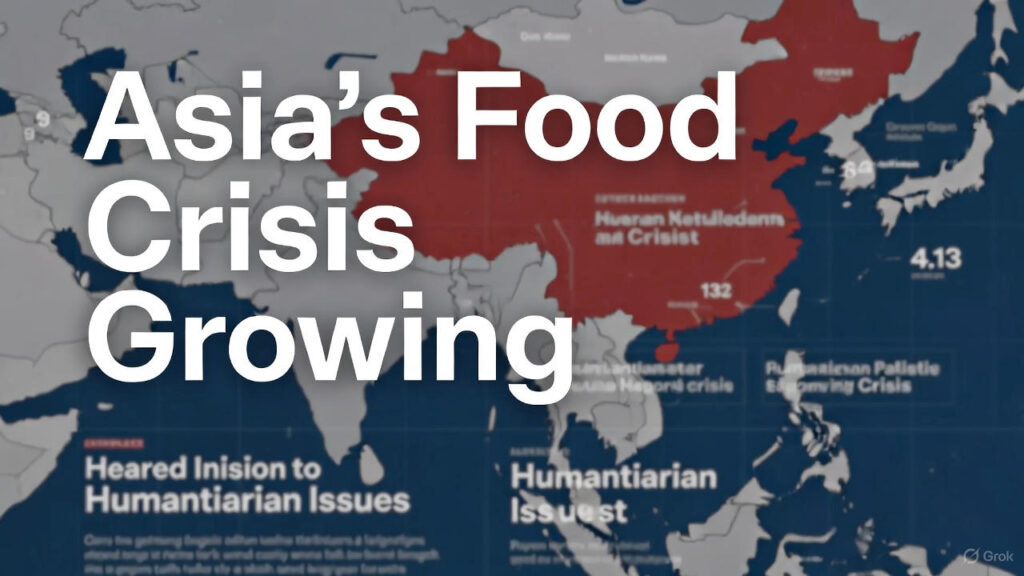
Asia and the Pacific—home to the world’s largest population—are now facing a massive food-security emergency that governments can no longer overlook.
According to the latest UN World Food Programme (WFP) Global Outlook, the region is entering 2026 along a worsening food-security fault line driven by conflict, climate disasters, and shrinking humanitarian budgets.
A staggering 69 million people are now severely food insecure, while an alarming 1.66 billion people cannot afford a healthy diet. Even in stronger economies, nutrition progress has stalled, making Asia the global epicenter of child undernutrition.
The region now accounts for more than half of the world’s stunted children and 70% of all severely malnourished children.
This is not just a humanitarian tragedy—it is a structural warning for Asia’s long-term stability.
Conflict and Climate Crises Are Driving Asia’s Food Insecurity
Two powerful, overlapping forces—conflict and climate change—are shaping Asia’s hunger map.
Afghanistan: A Country on the Brink
- 9.5 million people are severely food insecure.
- Program cuts have led to rising child malnutrition.
- Economic collapse and repeated droughts have made Afghanistan one of the world’s most aid-dependent populations.
Myanmar: Deepening Conflict and Displacement
- 12.4 million people urgently need food assistance.
- Ongoing conflict continues to reshape humanitarian priorities across Asia.
Pakistan: Climate Vulnerability Exposed
- Recurring monsoon disasters, including floods affecting 5.8 million people, highlight severe climate fragility.
- Limited financial resources make recovery extremely difficult.
This pattern of crises stretches across the region—from Cox’s Bazar where 1.3 million Rohingya refugees depend entirely on aid, to Nepal, Sri Lanka, and the Philippines, where inflation and climate shocks have sharply reduced food access.
Asia’s Rising Middle Class Cannot Mask Growing Nutrition Inequality
Asia is facing a growing paradox.
Despite rapid urbanization and increasing incomes, the region struggles with persistent undernutrition alongside rising obesity.
WFP notes that 41% of the world’s overweight adults now live in Asia, reflecting changing diets and widening inequality.
Countries such as India, Indonesia, and Vietnam face an invisible but intensifying burden—limited access to diverse, nutrient-rich foods that are essential for long-term health and productivity.
This “double burden of malnutrition” threatens the region’s future labor force, productivity, and healthcare systems.
Technology Is Transforming Food Distribution—But It Cannot Replace Funding
Asia has become a global hub for technology-driven food-security solutions.
- India’s Annapurti Grain ATM, which dispenses 25 kg of grain in seconds through biometric authentication, is a major innovation.
- AI-powered supply-chain systems and
- Satellite-based early-warning tools
are helping WFP respond faster to emergencies across Afghanistan, Pakistan, and Southeast Asia.
But the agency’s warning is blunt:
Technology cannot compensate for collapsing humanitarian budgets.
Funding for WFP fell 40% between 2024 and 2025, forcing cutbacks across Asia.
With shrinking preparedness and emptying buffer stocks, even moderate climate events in 2026 could trigger large-scale humanitarian disasters.
Asian Governments Are Responding, But Major Gaps Remain
Countries across Asia are expanding social protection, school meals, and nutrition programmes.
Indonesia, now emerging as a regional donor, has contributed US$12 million to Gaza relief.
However, structural gaps continue:
- South Asia’s public distribution systems are inconsistent.
- Southeast Asia suffers from limited safety-net coverage.
- Fragile states have weak or dysfunctional national systems.
WFP emphasizes that strengthening national food-security systems is now essential, as the agency can no longer operate at the massive scale seen between 2020 and 2023.
Strategic Risk: Asia’s Food Crisis Could Outpace Economic Growth
Food insecurity is no longer just a humanitarian indicator—it has become a strategic risk multiplier.
Asia’s hunger hotspots—from Afghanistan to Myanmar and coastal South Asia—have already demonstrated how food shortages can lead to:
- Social unrest
- Mass displacement
- Cross-border instability
With La Niña expected to distort rainfall patterns again, and economic pressures remaining high, Asia is entering 2026 with:
- Less fiscal space
- Reduced humanitarian support
- A more vulnerable population
The Year Ahead: Three Critical Questions for Asia
Asia’s outlook for 2026 depends on the answers to three uncertain but vital questions:
- Can governments protect vulnerable populations amid slowing economies?
- Will international funding stabilize after two years of steep decline?
- Can climate-related shocks remain within manageable limits?
WFP’s assessment is clear:
Asia remains resilient—but under increasing stress.
Even small shocks in the coming year could push millions more people into severe hardship, with consequences that extend far beyond food security.