China’s rapid dairy expansion has transformed it from the world’s largest importer into a surplus producer and emerging exporter. Slowing consumption and declining imports are reshaping global dairy markets, intensifying competition, pressuring prices and forcing exporters in New Zealand, the EU and the US to rethink long-term strategies.
For decades, global dairy markets followed a simple rule: When China bought more, prices rose everywhere else. As the world’s largest importer of milk powder, China’s demand dictates returns for dairy farmers in New Zealand, the European Union, the United States and Australia. Any slowdown in Chinese buying immediately hit global prices. That rule is now being broken.
China is undergoing a profound structural transformation of its dairy sector – transforming it from a demand-driven importer to a country struggling with surplus production and increasingly looking towards export markets. This shift is reshaping the global dairy trade, increasing competition and putting new pressure on international prices.
A decade long effort for self-reliance
China’s dairy transformation is rooted in a sustained policy effort toward food self-sufficiency. Growing rapidly after pandemic-era supply chain disruptions, Beijing encouraged the rapid expansion of domestic milk production through scale, technology and industrialization.
Small backyard farms have increasingly given way to large, industrial “mega-farms”. According to industry and government estimates, industrial operations now account for more than two-thirds of China’s total milk production. These farms rely on high-yielding imported cattle, improved genetics, automated milking systems and centralized feed management to maximize efficiency.
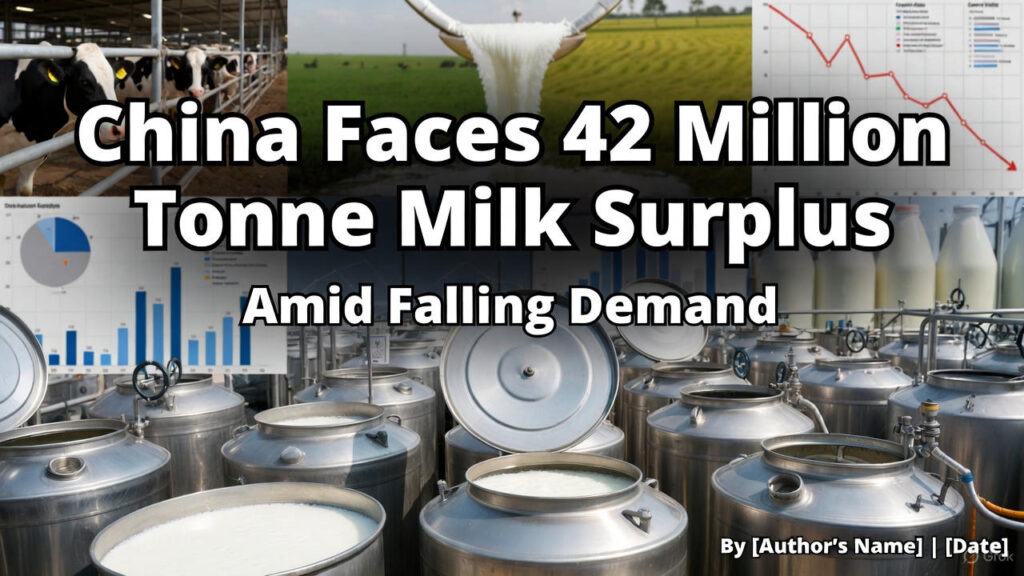
As a result, production has increased dramatically. China’s milk production is set to reach nearly 42 million tons in 2023, two years ahead of the government’s target of 41 million tons. For policy makers, this is a major achievement in reducing dependence on imports. (By comparison, India’s milk production exceeds 245 million tonnes, but most of it is consumed domestically.)
when supply exceeds demand
China’s production growth has rapidly exceeded consumption. Per capita dairy consumption in China has declined in recent years, from 14.4 kg in 2021 to 12.4 kg in 2022. The slowdown reflects several structural factors: a weak economy, cautious household spending, changing dietary habits, and – critically – China’s record-low birth rate, which has reduced demand for liquid milk and infant nutrition products. This widening gap between supply and demand has created a persistent surplus in the domestic market.
Raw milk prices have fallen below production costs, with prices sometimes falling below 3.8 yuan per kilogram, which is widely seen as the break-even level for many farmers. Loss-making operations have been forced to herd, delay expansion, or exit the industry altogether. Small farms have been hardest hit, while large corporate producers have also reported losses and herd reductions.
Industry analysts are describing China’s dairy glut as structural rather than cyclical – the result of long-term capacity expansion colliding with slowing consumption.
Imports declined due to increase in domestic production
As domestic milk availability increased, China’s appetite for imported dairy weakened. In 2023, total dairy imports declined by about 12%, while imports of whole milk powder – once the backbone of China’s dairy trade – fell by about 38%.
New Zealand remains China’s largest dairy supplier, but shipment volumes have declined sharply. The European Union and Australia are also facing similar pressure. For exporters long dependent on Chinese demand, the decline has forced a painful reassessment of market strategies.
From buyer to seller: China enters export market
The most important outcome of China’s dairy surplus is its emergence as an exporter, however modest. Chinese dairy products exports, led by milk powder, grew rapidly in recent years, reaching nearly 70,000 tons in 2024, up by nearly a third from last year. Powdered milk accounts for about half of these shipments, including to Hong Kong, Southeast Asia, Africa, the Middle East and parts of Central Asia.
While the volume of China’s exports is small compared to global giants such as New Zealand, the EU and the US, the shift is symbolically and strategically important. What was once the world’s most important buyer is now facing competition, especially in price-sensitive emerging markets. Major Chinese dairy companies such as Yili and Mengniu are actively expanding overseas, taking advantage of scale and competitive pricing to gain a foothold in new regions.
Global Waves: Prices, Competition and Strategy
China’s dairy pivot is causing a stir in global markets. First, excess Chinese supply is putting upward pressure on global milk powder prices, at a time when supplies from other exporters are also increasing. Analysts have warned of prolonged weak pricing, increasing instability for farmers around the world.
Second, competition is intensifying in the emerging markets of Asia, Africa and the Middle East – regions that were once growth engines for exporters from Oceania, Europe and the Americas. China’s geographical proximity, low logistics costs and aggressive pricing create new challenges for traditional suppliers.
Yet a paradox remains. While China has surplus liquid milk and powder, it is still dependent on imports for high-value dairy products such as specialty cheeses, butter and premium infant formula. Urban consumers continue to associate foreign brands with quality, safety and prestige, keeping these import segments relatively resilient. China’s dairy transformation marks a turning point – not just for its own farmers, but for the global dairy economy.
The change comes at a time when the United States and the European Union find themselves under pressure to push milk and other agricultural exports into global markets. Faced with domestic oversupply, climate-related cost pressures, and slowing consumption at home, both the US and the EU have stepped up efforts to secure market access to Asia, Africa and the Middle East through trade agreements and export incentives. In this crowded landscape, China’s emergence as an exporter is particularly significant: it is not only adding volume to global supply, but also competing directly with Western producers in the markets they are targeting for growth. Buyers that once absorbed surpluses from the US and Europe are now part of the competitive equation, complicating export strategies and increasing price pressures in global agricultural trade.