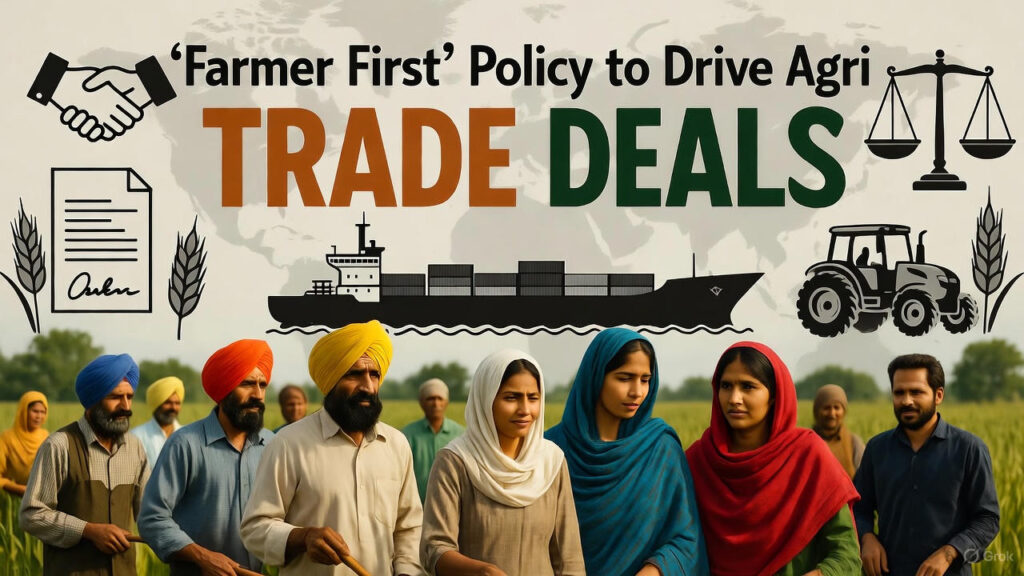
As trade talks with the US intensify, pressure is increasing on India to open up its vast agricultural sector. Reaffirming its “farmers first” policy, the government has vowed to oppose unreasonable demands that could harm domestic producers. Instead, India is focusing on self-reliance, export diversification, technology-driven farming and cooperative strengths to build a globally competitive and resilient agricultural system.
-
- India must stand up against unfair trade pressure
As India and the United States are negotiating to increase bilateral trade from US$ 128.78 billion (2022-23) to US$ 500 billion annually by 2030, agriculture has emerged as a contentious sector. The US is aggressively pushing for deeper access to India’s vast agri-market – an unrealistic demand that has irked Indian farmers.
In his Independence Day address on 15 August 2025, Honorable Prime Minister Shri Narendra Modi pledged to “stand like a wall” to protect the interests of farmers as a matter of policy. His determination reaffirmed India’s “Farmers First” policy, which was widely appreciated domestically and globally.
Even within the US, several policymakers and economists, including Jeffrey Sachs, criticized President Donald Trump’s tariff threats on Indian goods – calling them “bizarre and self-defeating”. Nevertheless, on 26 August 2025, Trump announced 25+25% tariffs on Indian exports.
Instead of wavering India, this challenge has strengthened the country’s resolve. Farmers, scientists and policy makers have seen this as an opportunity for agricultural transformation and self-reliance.
Understanding American Demand
Over the past decade, the US has repeatedly sought access to India’s US$452 billion agriculture market (expected to reach US$563 billion by 2030). US farmers facing domestic surpluses in soybeans, corn, wheat, fruits, dairy, poultry and meat look to India’s 1.46 billion consumers as a lifeline for their struggling agribusiness sector. Capturing a small portion of the Indian market would provide huge economic and political benefits to the American leadership. However, the American advantage is based on unfair competition. American agriculture often benefits in excess of $20 billion from annual domestic subsidies that create artificially low price points for their commodities. India cannot allow this highly subsidized, mechanized competition to destroy its domestic sector.
Why can’t India open its agricultural sector?
For India, agriculture is more than a commercial enterprise – it is the cornerstone of food and nutrition security and the primary livelihood for 45 percent of the workforce. This sector is the foundation of rural sustainability, employment and the Grow India@2047 vision.
Opening Indian markets to highly subsidized, mechanized American agriculture would harm domestic farmers and reverse decades of progress. India has already learned this lesson. Liberalization of imports of edible oils and pulses in the 1990s discouraged local production, leaving 57 per cent of edible oil (value Rs 1.38 lakh crore) and pulses (value Rs 42,629 crore) consumption dependent on imports. Recently, the government allowed duty-free import of cotton from September to December 2025, resulting in farmers being forced to sell their produce well below the MSP. In such a situation, cotton producers are facing huge losses this year. Entry into the US corn, soybean, ethanol, dairy, or poultry sectors would similarly disrupt energy self-sufficiency, domestic value chains, and farm incomes.
Security cover of MSP
Importantly, the Minimum Support Price (MSP) mechanism and India’s public stockholding program are non-negotiable safeguards. These initiatives ensure guaranteed income for small and marginal farmers, acting as an important protection against price volatility generated by subsidized international commodities. Eliminating or weakening this framework to satisfy trading partners will undermine the economic security and livelihoods of millions of small and marginal farmers across the country.
Self-reliance: shield against import disruption
Agriculture currently contributes 15-18 per cent to India’s GDP, and could soon exceed 20 per cent with the right policy, infrastructure and innovation support. The government’s increasing budgetary allocation—from ₹21,933 crore in 2013-14 to ₹1.22 lakh crore in 2024-25—reflects a strong commitment towards agricultural development.
Several new initiatives which are important and aimed at strengthening domestic production, reducing imports and building resilience are important and are given below:
Ø Cotton Mission to promote productivity and quality.
Ø National Mission on Edible Oils-Oilseeds (2024-31) to achieve self-reliance in major oilseeds.
Ø Pulses Self-reliant Mission for pulses (₹11,440 crore).
Ø Pradhan Mantri Fasal Bima Yojana (PMFBY) for comprehensive food and income security through crop insurance. PM Dhan Dhanya Krishi Yojana (₹24,000 crore) for food and nutrition security.
Ø Animal Husbandry, Fisheries and Food Processing Schemes (₹5,450 crore).
Ø PM Kisan Sampada Yojana for modern food processing infrastructure and value chain development.
Improvement in agricultural trade and exports
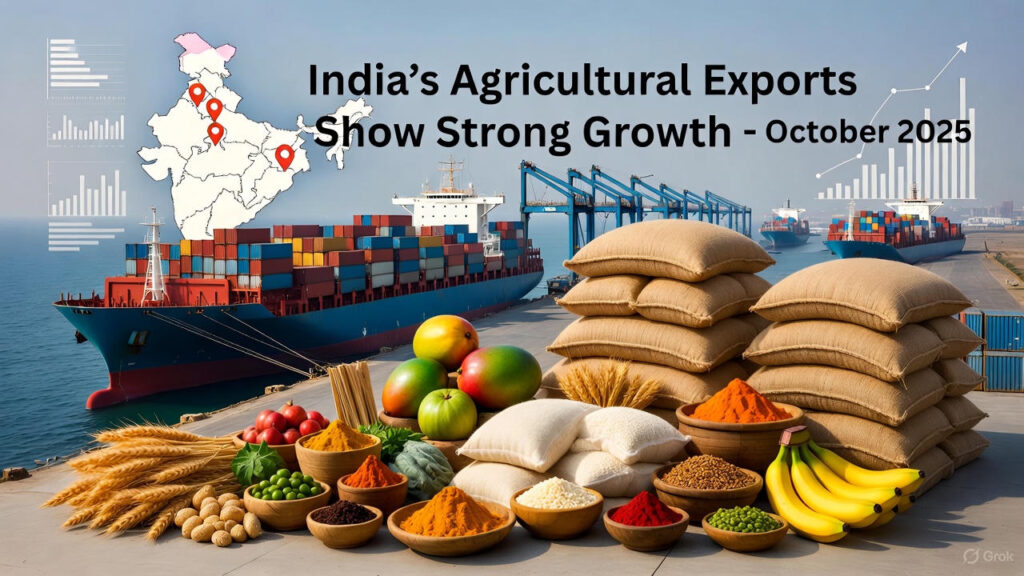
Before the US tariff increase, India had planned to increase agriculture exports from US$ 51.9 billion (2024-25) to US$ 100 billion by 2035. Exports to the US were US$5.7 billion (11% of the total), with more than half potentially affected by tariffs. In the long term, India needs to open up its markets, at least in proportion to what it wants from foreign markets. For this there is a need to improve trade and export policies. To sustain export growth, India will have to transform from a protected economy to a globally competitive economy:
§ Diversifying and upgrading its export portfolio with high value processed products.
§ Supporting MSMEs, FPOs and SHGs in processing, branding, cold chain and logistics.
§ Expanding market promotion in ASEAN, Africa, EU and the Middle East.
§ Ensuring stable export policies and avoiding repeated sanctions.
§ Meeting SPS and TBT standards through modern testing, traceability and certification.
§ Strengthening ease of doing business, innovation promotion and start-up ecosystem.
§ To follow the recommendations of Paroda Committee (2019) for empowerment and technical literacy of smallholders.
Empowering the new age farmer
Sustainable agricultural transformation depends not on subsidies but on knowledge, skills and innovation. Farmers must be equipped to adopt climate-resilient technologies, diversify production and connect to modern value chains.
Agri-startups in mechanization, logistics, food processing and marketing have already started attracting educated youth by offering dignity, profitability and purpose.
The High Powered Committee on KVKs (2014) under the chairmanship of Dr. RS Paroda recommended converting all 731 KVKs and 691 ATMA centers into “Gyan-”.
Skill-Innovation Centre.” Workshop on Motivating and Attracting Youth in Agriculture (MAYA) also proposed the following reforms:
· Reshaping the agriculture curriculum.
· Institutional support for entrepreneurship.
· Vocational training in ICT, high value crops and supply chain management.
The vision of a developed India is heavily dependent on digital public infrastructure (DPI) in agriculture. Initiatives related to digital services will provide personalized advisory services, credit access and market linkages, ensuring that technological advancements are inclusive and scalable for India’s millions of small farmers.
Reimagining Agricultural Education
The agriculture of the future will be knowledge-intensive, powered by artificial intelligence (AI), biotechnology, robotics, drones, block chain and precision farming. Integrating agriculture with science, engineering, technology and mathematics (STEM) subjects will foster innovators capable of creating indigenous as well as globally competitive solutions. However, such a transformation requires strong funding for higher education and research to ensure that technology-driven agriculture remains inclusive and sustainable.
building cooperative power
Small farmers often find it difficult to adopt technology due to lack of awareness and limited financial resources. Strengthening Primary Agricultural Credit Societies (PACS) and linking them with Farmer Producer Organizations (FPOs) and Self-Help Groups (SHGs) can provide credit access, storage and equipment on a custom-hiring basis. An integrated production-to-market cooperative network can significantly improve farmers’ profitability and resilience.
Protecting India’s agricultural identity
India must protect its domestic agriculture and food industries by improving efficiency and competitiveness. Promoting “Make in India” agricultural brands and building consumer confidence in local products is a step in the right direction. Ultimately, India’s success will depend on its ability to rapidly address tariff and non-tariff barriers, enhance policy framework and infrastructure, and establish its agriculture sector as a globally reliable, competitive and self-reliant system.
At the end,
The “Farmers First” policy is not just a slogan – it is the foundation of India’s food security, rural sustainability and national sovereignty. Due to the current trade pressure from the United States, opening the doors to cotton, corn, soybean, dairy products, meat, etc. is likely to adversely impact Indian farmers, especially when efforts are towards self-reliance. Instead, policy support for growing GM food crops like maize and soybean will help scale up production more efficiently and make our agriculture globally competitive. The success story of BT cotton is a vivid example of this. With a well-planned coordinated and long-term EXIM policy – India stands to gain hugely, but will require an enabling policy environment and a strong incentive to aggressively pursue ‘Make in India’ innovations.
-
- Dr. RS Paroda is the Chairman of the Trust for Advancement of Agricultural Sciences (TAAS); Former Director General, ICAR and Secretary, Department of Agricultural Research and Education, Government of India
-
- Dr. Ram Srivastava is Professor (Retd), Haryana Agricultural University; Consultant, Krishi Vigyan Unnati Trust (TAAS)