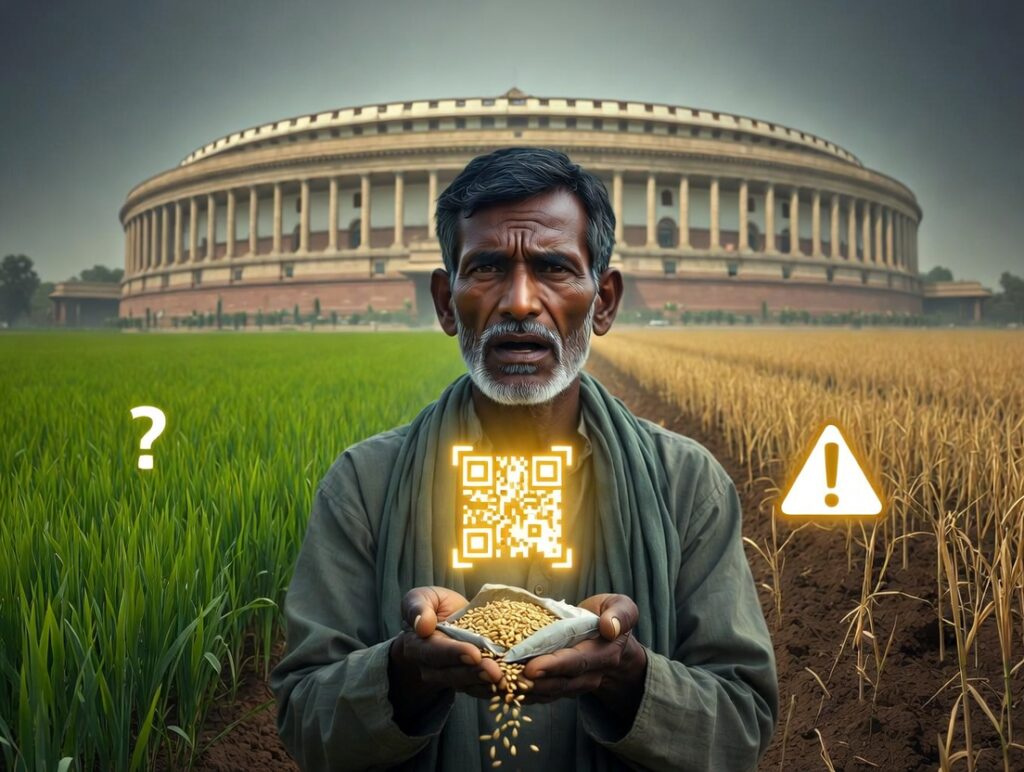
The Center on Friday admitted that there is no provision in the draft Seed Bill to compensate farmers and in case of loss caused by the fake seeds, they will have to approach consumer forums to claim compensation. The government also said the price control order would be imposed only in exceptional circumstances, while companies would be allowed to sell at the rates set by them.
Speaking to the media at his residence in Delhi, Union Agriculture Minister Shivraj Singh Chouhan avoided the question as to who will compensate the farmers if their crops are damaged due to fake seeds. When asked who would compensate farmers if they suffer losses due to seeds – the government or companies – he said consumer protection laws would be implemented more effectively.
The minister, replying to a question on price control of seeds, said that generally the retail price has to be printed on the pack. “But, if there is an extraordinary situation, when a complaint is received about abnormally increasing rates by a company, the government will intervene in such a situation,” Chouhan said.
After curbing Bt cotton prices, private companies have not released any new technology in India, sparking debate on the need for price controls on seeds. The government has been fixing the maximum retail price of one seed packet (450 grams) of Bt cotton every year. Industry experts said prices of no other seed are controlled.
The minister also said that currently farmers do not know where the seeds come from or where they are produced. But under the draft Seed Bill there will be a complete traceability system. Nearly 14,000 feedbacks have been received in a month after the government put the draft in the public domain in November 2025.
Chauhan said, “With this traceability system, as soon as you scan the QR code, you will know where the seeds were produced, the source will be identified. This will ensure that substandard seeds do not enter the system. And if they do, they will be caught and can be punished.”
Emphasizing that seed companies and wholesalers will be registered, the minister said farmers will not face any problem if they sell their seeds. He said the traditional practice of farmers supplying seeds to other farmers and receiving returns in the form of crop (under a particular ratio) would not be disturbed by the proposed seed law.
Chauhan said, this misconception is being spread that the new law will affect traditional seeds, which is not true. Additionally, if it is found that the seeds are substandard, have low germination, or pose any other problem, the penal provisions have been strengthened under the Bill.
He said, “At present the fine is up to Rs 500. Now there is a proposal to impose a fine of up to Rs 30 lakh, although many suggestions are coming in. If the crime is very serious, that is, it is done intentionally, then there is a provision for imprisonment.”
“Not all companies are bad, I am not saying that. Good companies will be able to provide good seeds and strict action will be taken against those involved in malpractices,” he said.
Chauhan said that there is no proposal to stop seed import, but there will be a complete regulatory system for this, it will be thoroughly evaluated. “Any seed will be allowed to be imported from abroad only after a complete assessment of whether it is suitable for our agro-climatic conditions or not,” he said.