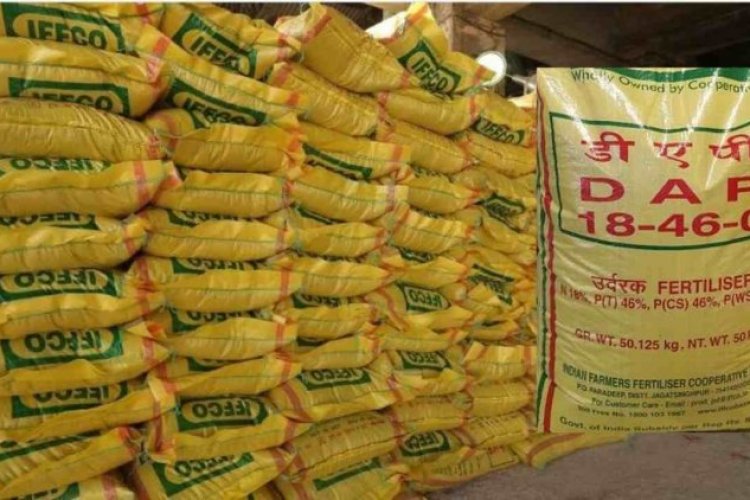
Global prices of di-ammonium phosphate (DAP) have risen by more than $50 to $730 a tonne in two weeks due to aggressive buying by Brazil and export restrictions by China. With India dependent on imports and the Kharif season approaching, importers are awaiting clarity on nutrient-based subsidy rates. While MRP is stable at Rs 1,350 per bag, uncertainty remains on the supply side.
Global prices of di-ammonium phosphate (DAP), the second most consumed fertilizer in India after urea, have surged by more than $50 a tonne in the past two weeks, raising concerns over timely availability for the upcoming kharif season.
According to industry sources, DAP prices in the international market are currently hovering between $720 and $730 per tonne, up from $665 to $670 per tonne about a fortnight ago. Prices could rise further after Brazil reportedly struck a deal at $740 a tonne, especially with Saudi Arabian producer Maaden.
India consumes about 10 million tonnes of DAP annually, with most of its requirement met by imports. About 40 percent of imports consist of raw materials used for domestic production, while about 60 percent is imported in the form of finished fertilizers.
Brazil purchases, pressure increased due to China’s export restrictions
Industry sources say global prices are strengthening amid strong Indian demand and expectations of aggressive buying from Brazil. Brazil has reportedly secured large volumes at higher prices, including deals with Saudi Arabia’s Maaden for up to $740 a tonne.
Additionally, export restrictions imposed by China, the major global DAP exporter, are reducing supply and putting upward pressure on prices.
India has entered into long-term supply agreements with Russia and Saudi Arabia’s Maden to ensure stable DAP availability. A long-term agreement with Russia covers 600,000 tonnes. However, sources say Russia did not supply contracted quantities in February and is now proposing shipments in mid-April. Imports arriving in April may pose logistical challenges in ensuring timely availability for the Kharif sowing season.
Meanwhile, Madden is currently preferring Brazil over India for supplies, which has increased uncertainty in the market.
Importers are waiting for NBS rates
The current price volatility has put importers in a dilemma. One major reason for this is the government’s subsidy structure under the Nutrient-Based Subsidy (NBS) scheme.
Under the NBS system, the government fixes per kilogram subsidy rates for nutrients such as nitrogen (N), phosphate (P), potash (K), and sulfur (S). Based on import and production costs and notified subsidy rates, companies are allowed to determine the maximum retail price (MRP) of deregulated fertilizers.
The government announces different NBS rates for Rabi and Kharif seasons. Companies assess the feasibility of importing or producing based on these rates and set the MRP accordingly.
Although non-urea fertilizers have been officially deregulated, the MRP of DAP is effectively under indirect government control. The MRP of DAP has remained unchanged at Rs 1,350 per 50 kg bag for the last three years. The difference between the fixed MRP and rising import or production costs is compensated by the government through subsidies. A large portion is covered under the NBS scheme, while additional losses have been addressed through special incentives.
The government has assured the industry that it will bridge the gap between import cost and MRP. However, most importers are waiting for the revised NBS subsidy rates applicable from April 2026 for the upcoming Kharif season before committing to large import contracts.
Industry wants long term policy
Industry sources told Rural Voice that the existing subsidy mechanism often hinders timely fertilizer availability. They argue that a long-term and predictable subsidy framework, similar to the system for urea, will ensure smooth supply.
Urea remains a fully controlled fertilizer, with the government regulating its pricing, import and distribution. Companies are reimbursed the entire difference between the MRP and the cost of production or import.
limited immediate impact
Despite the sharp rise in global prices, the immediate impact of DAP on farmer-level prices is expected to be limited, given the government assurance on fixed MRP and subsidies.
However, prices of other complex fertilizers have increased in recent years. Consumption of alternative complex fertilizers has already increased due to low availability of DAP.
Another major challenge for the government is to promote balanced fertilizer use. Last year’s data shows that the consumption ratio of N, P and K nutrients has deteriorated significantly. Urea consumption remains more than double the ideal level, undermining efforts to encourage balanced nutrient application in Indian agriculture.