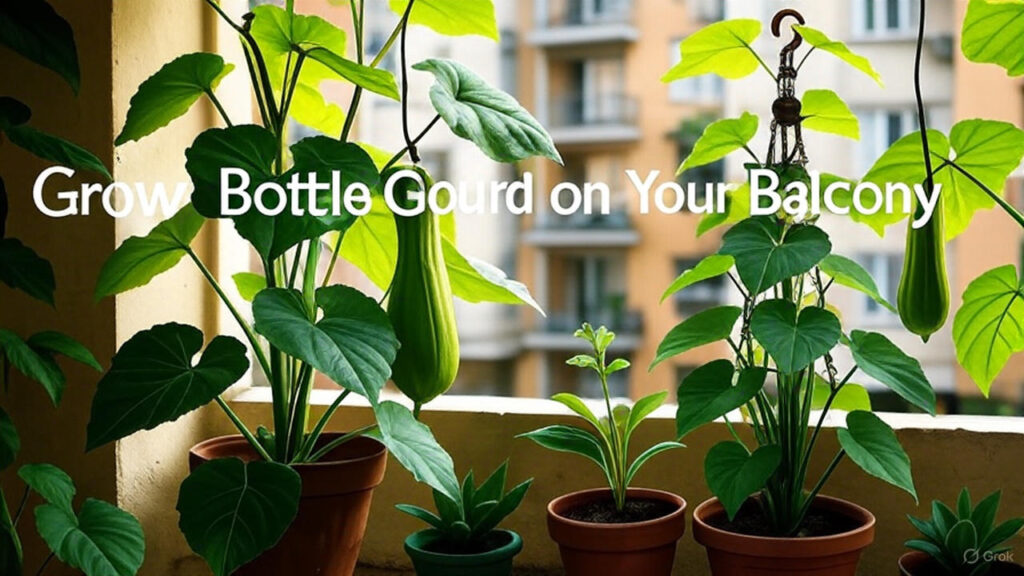
Hello Indian gardeners, We are excited to present a comprehensive guide on growing bottle gourd on your balcony, including step-by-step instructions for planting and caring for lauki in your apartment. You’ve probably noticed how that tiny balcony of yours—maybe a cramped corner with a rickety chair and some drying clothes—feels like it’s begging for something more, right? Honestly, I’ve been there, staring at my own 6×4-foot space in a Mumbai flat, wondering if I could grow anything edible. It turns out that you can cultivate bottle gourd, also known as lauki, in a pot no larger than a kitchen bucket, which is truly revolutionary. People are harvesting fresh, chemical-free lauki at home, from Patna to Hyderabad.
You don’t need a sprawling farm or even proper soil. All it takes is a reused container—like that old 20-litre water drum you’ve got lying around—and some know-how about timing for your city. So, let’s explore effective strategies for growing lauki in small spaces when time is limited and you want to avoid unknown additives.
Bottle Gourd (Lauki) – Plant Profile
| Attribute | Details |
|---|---|
| Scientific Name | Lagenaria siceraria |
| Common Names | Bottle Gourd, Lauki (Hindi), Doodhi, Ghia, Sorakaya (Telugu), Dudhi (Marathi), Calabash, White-Flowered Gourd |
| Family | Cucurbitaceae (Gourd family – same as pumpkin, cucumber, bitter gourd) |
| Plant Type | Annual climbing vine – grows fresh every year, dies after fruiting |
| Vine Length | Can stretch 10 to 30 feet (3 to 9 meters) – needs vertical support even on small balconies |
| Fruit | Smooth green skin, bottle- or round-shaped. Eaten young (15–30 cm / 6–12 inches long). If left to mature, skin hardens into a shell. |
| Maturity Time | 60–75 days days for tender, edible lauki 120–180 days days for hard-shelled gourds (used as containers or ladles) |
| Flowers | Monoecious – male and female flowers grow on the same plant. Male flowers appear first; female flowers have a tiny fruit at the base. |
| Pollination | Needs bees or wind – but in apartments, hand-pollination (using a soft brush) gives better fruit set |
| Uses | Culinary: Sabzi, dal, juice, halwa Traditional: Mature gourds dried and used lota, chilams, or decorative bowls in rural India |
| Nutritional Value | Very low in calories, high in water content. It serves as a good source of fibre, vitamin C, vitamin K, calcium, and potassium, making it an ideal choice for a summer detox. |
| Cultural Significance | In many Indian households, a dried bottle gourd is considered auspicious. Dried bottle gourds are used in rituals, as water containers, and even as musical instruments, such as ektara resonators. |
Best Container for Bottle Gourd in Small Spaces

Don’t Skimp on Pot Size
A 10-litre pot might seem huge, but trust me, it’s not enough for lauki. Those roots need space to stretch deep and wide. Skimp on size, and your plant will just limp along—fewer flowers, puny fruits, and wilting in the summer heat of places like Nagpur or Ahmedabad. Go for a container at least 18 inches deep and 16 inches wide. A 20-litre HDPE water drum, a sturdy plastic bucket, or even a big clay matka does the trick. These hold moisture longer, which is a lifesaver during scorching afternoons.
Use What’s Already at Home
Why splurge on fancy planters? Some of the best lauki crops come from stuff you’ve already got. Do you have a dusty Bisleri jar lying around? Please clean it thoroughly and drill 5–6 holes in the bottom, and it will be ready for use. My friend Ramesh in Bengaluru’s Indiranagar swears by this. He snagged a 20-litre oil container for ₹20 from a mechanic, washed it with soap, let it sun-dry, and filled it with a cocopeat mix. “Last winter, I got nine laukis from one pot,” he told me, grinning. You can even repurpose broken plastic drums from construction sites—just line them with old cloth if the edges are sharp.
Weight Matters on Concrete Balconies
A filled 20-litre pot weighs about 22 kilos. Most modern balconies in Indian apartments can handle it, but if you’re in an older building in Kolkata or Mumbai, be careful. Don’t stack heavy pots near the railing; keep them close to the wall. In my high-rise, I stick to one or two big containers. For extra stability, toss some small stones or broken bricks at the bottom before adding soil. It helps with drainage too.
| Container Type | Minimum Size | Weight (Filled) | Cost |
|---|---|---|---|
| HDPE Water Drum | 20 liters | ~22 kg | ₹20 |
| Plastic Bucket | 18 in deep, 16 in wide | ~20 kg | ₹50 |
| Clay Matka | 18 in deep, 16 in wide | ~25 kg | ₹100 |
Soil Mix That Actually Feeds Your Lauki
Skip Garden Soil Alone
Beginners often make the mistake of using just garden soil. It turns rock-hard over time, choking roots from air and water. Instead, mix 40 percent cocopeat (you can grab it for ₹30–40 per kilo at Delhi’s Krishna Market or Chennai’s Koyambedu), 30 percent well-rotted cow dung compost or vermicompost, and 30 percent garden soil. This combo stays loose, holds water without getting soggy, and lets roots breathe. In dry spots like Rajasthan or Gujarat, that’s a big deal.
Add Compost, Not Just Fertilizer
Young lauki plants are delicate. Chemical fertilisers, like urea, can burn roots. Stick to organic stuff. Well-decomposed cow dung compost is like gold—it feeds slowly and builds better soil. In Tamil Nadu and Andhra Pradesh, folks sprinkle wood ash from kitchen stoves when flowers show up. It’s potassium-rich and helps female flowers turn into plump fruits. My neighbour Meera in Coimbatore tried this recipe and said, “My lauki fruited ten days faster!”
Refresh Soil Between Seasons
Don’t just reuse old soil. After harvest, spread it on a cloth in the sun for three days to zap pests and fungi. Mix in 30 per cent fresh compost before replanting. Sunita from Indore does this every November, and her winter crop always pops with darker, healthier leaves and fewer yellow spots.
| Soil Mix Component | Percentage | Purpose |
|---|---|---|
| Coco peat | 40% | Keeps soil loose, retains moisture |
| Cow Dung Compost | 30% | Adds nutrients, improves structure |
| Garden Soil | 30% | Provides stability, basic nutrients |
Choose the Right Lauki Seeds—Not Just Any ‘Desi’ Packet
Go for Proven Varieties
Not every “desi” seed packet is worth it. Cheap ones from roadside stalls often give weak vines or low yields. In my experience, sticking to trusted varieties makes all the difference. Try these:
- Pusa Naveen: Matures in 55 days, compact vines—great for balconies.
- COBH-1 (from TNAU): Heat-tolerant, perfect for South India.
- Arka Bahar: Fights mosaic virus, ideal for North and East India.
For region-specific advice—especially if you’re in South India—Tamil Nadu Agricultural University’s bottle gourd cultivation guide lists proven varieties like Arka Bahar and TNAU CO1, along with sowing times and organic pest control methods tested in Indian conditions.
Where to Buy Reliable Seeds
Check labels at Krishi Seva Kendra or Agri Stores. Skip those sketchy, unlabelled packs. In Pune or Lucknow, shops near agricultural universities have the excellent stuff. A 10-seed pack runs ₹10–15—cheap for the peace of mind.
Don’t Save Hybrid Seeds
Hybrid seeds (marked “F1”) won’t grow true if you save them from your fruit. Stick to open-pollinated types like Pusa Naveen for seed-saving.
Step-by-Step: How to Sow Bottle Gourd Seeds in Pots
Prep Seeds the Night Before
Don’t toss dry seeds into soil. Soak them in room-temperature water for 8–12 hours overnight. It softens the shell and cuts germination time by a couple of days. But if it’s scorching (over 35°C), skip soaking to avoid rot.
Here’s How to Sow Right
- Fill the pot, but do not fill it to the brim: Load your container with the cocopeat-compost mix, leaving 2 inches at the top. This stops soil from spilling when you water—saves a mess on tiled balconies in Hyderabad or Ahmedabad.
- Sow 1 Inch Deep: Poke a hole with your finger, about the length of your first knuckle (1 inch). Drop in 2–3 seeds, spaced 3 inches apart. Cover lightly—don’t pack it down. Ramesh in Bengaluru learnt these lessons the hard way: “I pressed too hard my first year. Only one seed sprouted. Now I just pat gently.”
- Water Gently: Use a watering can with a rose head or a bottle with tiny cap holes. A concrete stream can bury or expose seeds. Keep soil moist (not soggy) for 5–7 days. Germination loves 25–32°C daytime temps.
- Thin Early: When seedlings get two true leaves (10–14 days), snip weaker ones at soil level with scissors. Don’t pull—they’ll mess up the keeper’s roots. One strong vine per pot beats three crowded ones.
Sow at the Right Time—By Your City
Winter Sowing in North India
In Delhi, Lucknow, Jaipur, or Chandigarh, sowing occurs from late October to mid-November. Daytime temps of 25–30°C are perfect, and nights aren’t too cold. If frost hits (like in Punjab or Haryana), cover seedlings with an old saree or polythene over a bamboo frame. Take it off by 9 a.m. to avoid overheating. Sow 2–3 seeds per pot, 1 inch deep, and thin to one after two weeks.
Year-Round Growing in the South
In Bengaluru, Hyderabad, Coimbatore, or Kochi, you can grow lauki almost anytime. But September–October (post-monsoon) or February–March (pre-summer) work best. Avoid July–August; constant rain rots seeds, and humidity breeds fungi. In Chennai’s long summers, shade pots with coir mulch to keep roots cool.
Summer Strategy for West & Central India
In Mumbai, Pune, Ahmedabad, or Bhopal, sow in November for winter harvests or January for summer crops. East-facing balconies enjoy soft morning sun, sparing vines from harsh afternoon heat. In April–May, when temps hit 38°C, shade pots with a green net or park them behind a curry leaf plant. Water early morning and at dusk.
| Region | Best Sowing Time | Tips |
|---|---|---|
| North India | Late Oct–Mid Nov | Cover for frost protection |
| South India | Sep–Oct, Feb–Mar | Use coir mulch in summer |
| West & Central India | Nov, Jan | Shade pots in peak summer |
Watering Your Lauki Like a Pro
You’ve probably noticed how tricky watering can be. Too much, and your roots rot; too little, and your vine wilts faster than you can say, “lauki sabzi”. Getting it right depends on where you are and what season it is. In winter, like in Delhi or Jaipur, water every 2–3 days when the top inch of soil feels dry—stick your finger in to check. In summer, think Mumbai or Ahmedabad heat above 38°C; you’ll need to water early morning and again at dusk to keep the plant happy. Monsoon presents a distinct challenge. Ease up—only water if the soil’s dry, and never let pots sit in puddles. I discovered these lessons firsthand when my first plant drowned in a rainy July in Pune. Here’s a quick guide:
- Winter: Water every 2–3 days; examine soil first.
- Summer: Water morning and evening if above 38°C.
- Monsoon: Water sparingly; elevate pots on bricks to avoid puddles.
Why Your Lauki Dies in Monsoon (And How to Stop It)

Fungal Attacks Are the Real Killer
Monsoon can wreck your lauki crop. It’s not you—it’s downy mildew and fruit rot from wet leaves and poor airflow. Pretty sure that’s why my first attempt in Mumbai flopped.
Preventive Spray That Works
Mix 1 litre of milk with 2 litres of water and spray weekly during the monsoon. Sounds weird, but milk cuts fungal growth—TNAU backs the idea up. Spray early so leaves dry fast.
Elevate, Prune, and Air Out
Raise pots on bricks to avoid puddles. Prune lower leaves that touch soil. My friend Priya in a Mumbai high-rise ties her vines to ceiling strings, keeping fruits off wet railings. “Zero losses last monsoon,” she bragged.
Train Vines Without Taking Over Your Railings

Build a Simple Bamboo Trellis
Lauki vines can hit 10 feet—they’ll sprawl everywhere without support. Grab 5–6 bamboo sticks (₹10–15 each at any sabzi mandi) and tie them into a 5-foot A-frame with jute string. Guide the main stem of the plant upward and wrap its tendrils around a support structure. Use soft cotton cloth ties—plastic twine cuts stems in windy spots like Goa or Mangalore.
Use Your Balcony Rail Smartly
Tight on space? Turn your railing into a climbing wall. Tie coir rope or jute string from the pot to the ceiling. Lauki tendrils love rough surfaces. Meera in Chennai leaned an old window grille against her wall for vertical growth without eating floor space. Just ensure it’s stable—a falling trellis can snap stems.
Prune to Keep Airflow Moving
Pinch off side shoots after the fifth true leaf. This practice focuses energy on the main vine and prevents crowding. In humid Kolkata or Guwahati, dense leaves trap moisture, inviting mildew. Pruning keeps air moving and makes spotting fruits easier.
Cost and Profit: Is Growing Lauki Worth It?
Total Startup Cost: Under ₹150
Here’s the breakdown (2025 prices):
- Reused 20-liter drum: ₹20
- Cocopeat (2 kg): ₹60
- Seeds (10): ₹15
- Bamboo sticks: ₹30
- Total: ₹125
Market Savings Add Up Fast
One lauki costs ₹25–40 at markets. A single plant yields 8–12 fruits—that’s ₹200–480 of chemical-free lauki. Sunita in Indore says, “I spent ₹130 in November and ate free lauki until February.” This sounds pretty solid, doesn’t it?
In case you are interested, check how this farmer is earning 18 lakhs from his bottle gourd farm.
Zero-Cost Swaps
Use kitchen waste compost instead of vermicompost. Collect rainwater. Tie vines with old rags. Every rupee saved makes this job more doable.
| Item | Cost | Alternative |
|---|---|---|
| 20-liter Drum | ₹20 | Free from construction sites |
| Coco peat | ₹60 | Rice husk (free from mills) |
| Compost | ₹50 | Kitchen waste compost |
10 Bottle Gourd Growing Hacks Every Indian Balcony Gardener Should Know

- Soak seeds overnight—cuts germination by 2 days.
- Place a clay tile under young lauki to stop rot—free from pottery shops.
- Hand-pollinate at 7 a.m. with a soft brush—key in high-rises with no bees.
- Spray the neem-garlic mix weekly when flowers bloom—it keeps fruit flies away.
- Using rice husk mulch, which is obtained for free from mills, reduces summer watering by half.
- Use broken clay over drainage holes—better than plastic mesh.
- Pinch the main tip after 5 leaves—sparks more flowers.
- Harvest every 2–3 days in summer—overripe lauki saps the plant.
- Grow near mint or marigold—natural pest repellents.
- Save seeds from the straightest fruit—my grandma swears it gives stronger vines.
Fix Common Problems Before They Spread
There are flowers, but there is no fruit.
Poor pollination is usually the culprit. Male flowers (on thin stems) come first; female ones have a tiny lauki at the base. Brush pollen from male to female between 6 and 9 a.m. In high-rises with no bees, this recipe is a must. Ramesh in Bengaluru does it every other day and gets fruit on 90 per cent of female flowers.
Leaves are turning yellow?
The cause could be overwatering, low nitrogen, or a mosaic virus. If only lower leaves are yellow and new ones are green, it’s probably just ageing. If all leaves are pale, check soil. Add two handfuls of vermiculite and a small amount of water if it’s dry. Mottled patterns? It could be a mosaic virus, in which case you should remove the plant to prevent it from spreading.
Fruit rots at the Base?
Young lauki touching wet soil rot fast. Slip a clay tile, coconut shell, or cardboard under them. In humid spots like Siliguri or Shillong, this method can double your harvest.
From Harvest to Kitchen: What to Do With Fresh Lauki

Store Without a Fridge
Wrap the unwashed lauki in a newspaper and stash it in a cool, dry kitchen corner. It can remain fresh for 5–7 days without the need for refrigeration.
Cook Young, Juice Old
Tender lauki (30–40 cm) is perfect for sabzi or dal. Overgrown ones? Blend them into juice—North India loves this recipe for summer detox.
Save Seeds the Traditional Way
Let one fruit ripen fully until the skin’s hard and brown. Scoop seeds, wash off pulp, and dry in shade for 3 days. Store in a paper envelope—plastic breeds mould. My aunt in Amritsar labels her seeds with the date and variety, and this method has been effective for years.
6 FAQs About Growing Bottle Gourd in Pots
1. Can I grow bottle gourd on a small Indian balcony?
Yes. One 20-litre pot, 4–6 hours of sun, and a bamboo stick to climb—plenty for fresh bottle gourd.
2. How many lauki plants per pot?
Just one. If you plant more than one, they will crowd each other and produce fewer fruits.
3. Why are my bottle gourd leaves turning yellow?
Usually, it’s due to overwatering or poor soil. Water the bottle gourd only when the top 2 inches of soil are dry, and also add compost to improve soil quality.
5. Do I need to pollinate bottle gourd flowers myself?

Yes, especially in apartments. Use a soft brush early morning to move pollen from male to female flowers.
6. What pot size is best for growing bottle gourd?
Minimum: 20 litres—18 inches deep. Reused drums or buckets work fine if cleaned and drained well.
7. When can I harvest a bottle gourd?
In 55–70 days. Pick when 30–40 cm long—tender and sweet. Don’t wait until they’re huge.
8. Why is my bottle gourd plant dropping flowers?
The most common causes are either poor pollination or stress, such as excessive watering, insufficient sunlight, or sudden heat. Hand-pollinate flowers early morning, and avoid overwatering during flowering.
Share Your Lauki Journey
Do you have a unique story to share about your experience with Lauki? Maybe you harvested a massive fruit in Bengaluru or saved your vine from monsoon rot in Kochi. Sharing your tips with other balcony gardeners is how we all get better at this. Drop your tricks or questions in the comments—I’d love to hear how your plants are doing! What’s worked for you? Any hacks you swear by? Let’s grow this community together.
Final Tips for Your First Harvest
Look, growing lauki on your balcony doesn’t need to be perfect—it’s about getting started. One healthy vine in a 20-litre drum can feed your family for weeks, with no chemicals involved. Pick fruits young, tie vines gently, and don’t shy away from pruning. Whether you’re in chilly Shimla or humid Kochi, fresh lauki is doable. Grab a pot, some seeds, and a sunny corner this week. Your first homegrown bottle gourd will taste way better than anything from the market—and that’s something every Indian gardener should experience.