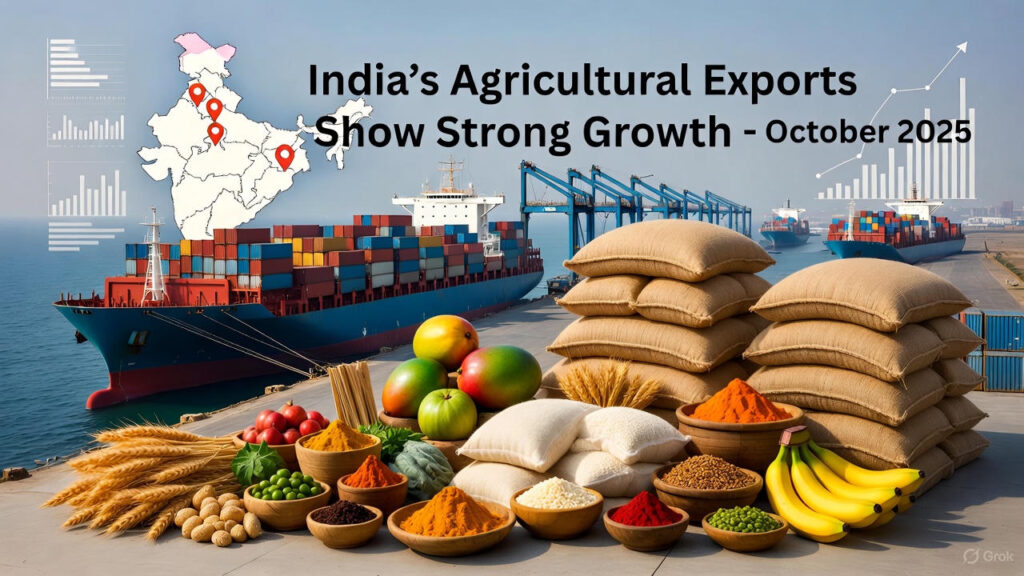
Exports from agriculture and allied sectors in India have witnessed a huge growth from about $41 billion in FY 2020-21 to about $51-52 billion in 2024-25 (provisional estimates), which is quite resilient. The target is to achieve $100 billion in food, agriculture and marine exports in the coming years.
The Union government and industry ministers have indicated that a combined $100 billion target for food and beverage, agriculture and marine exports is feasible within a multi-year horizon, implying sustained 14-15 per cent compound growth in those sectors.
To achieve this there is a need to move beyond short-term fiscal incentives and move towards a systemic cooperation by fixing supply-side bottlenecks, enhancing value addition and reliable market access.
Why is industry-government cooperation necessary?
Given the following characteristics of India’s agricultural exports, long-term cooperation between policy and industry association is necessary:
1. Differences in infrastructure and supply chain: Demand for cold chains, quality-assured packaging and wholesale markets for perishable goods. India faces a measurable shortfall in modern cold-storage and it is estimated that there is a large unmet storage demand.
2. high post-harvest losses: Post-harvest losses and quality rejections reduce exportable quality and increase the cost of doing business for the buyer who demands quality and hygiene standards.
3. multiple institutional framework: Multiple agencies (APEDA, State agencies, Customs, Port authorities) and policies. Yes, APEDA has an important role in promotion and standards, but $100 billion worth of exports need more predictable investment-grade policies.
4. Market access and non-tariff barriers: Export expansion is based on adherence to foreign food safety policies of importing countries and active market development activities. Therefore, intensified government diplomacy and industry is the need of the hour.
Transforming India’s agricultural export potential into $100 billion requires collaboration between policymakers and industry leaders. How can we do this? First, enable world-class logistics and cold-chain infrastructure while leveraging economies of scale through integrated farm-to-port hubs and public support that can reduce private investment risk.
Second, make compliance with standards mandatory with some operational flexibilities through harmonized digital certification and district-level accredited testing agencies to reduce export rejection risks.
Third, support the creation of demand and market access through a combination of trade missions and buyer-seller meetings to overcome non-tariff barriers. Fourth, align financial and risk management tools and insurance products to the seasonality and perishability of agricultural products.
Furthermore, we need to strengthen data and R&D linkages to upgrade the export product basket.
cooperation system
These mechanisms are practical levers that have been used elsewhere and can be scaled up in India:
1. Public-Private Cold Chain Cluster (PPP AEZ)): Identified Agricultural Export Zones (AEZ) where the Government can provide land/connectivity, and the private sector develops cold chains and packaging houses. Government may co-finance the initial capex to reduce IRR constraints and build on the existing AEZ policy under APEDA.
2. Co-create Centre-State investment roadmap: The Center and states need to create investment roadmaps with time-bound targets for renewable energy for warehousing, inland container depots, air freight slots and cold storage.
3. market access: A task force between the commerce ministry and industry associations to target 4-6 new markets per commodity along with digital buyer introduction to mitigate risk.
4. Design finance products led by banks and government to reduce risk. New financial products catering to working capital, receivables financing and freight guarantees taking into account seasonal cycles. Also, partial public credit guarantee will be provided for new export categories to de-risk new exporters.
5. Capacity Building and Quality Testing Laboratory Network. Industry can fund joint training programs for farmer producer organizations and packaging house staff on international export standards, as well as accredited laboratories near export clusters.
To keep the collaboration effective, we need to set and measure quarterly KPIs like new export product category, cold-storage capacity added (MT), number of accredited laboratories and APEDA e-certificate transactions etc. to create conditions for achieving the $100 billion objective.
The author is CEO and General Secretary, PHDCCI
Published on February 15, 2026