NDA’s Historic MSP Promise: Reform or Risk?
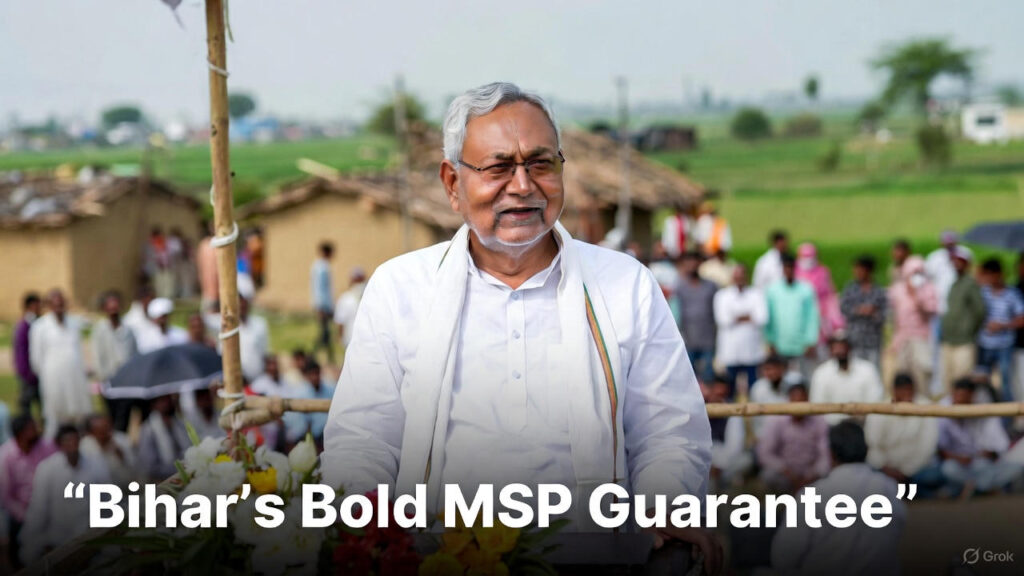
The NDA’s promise of a universal Minimum Support Price (MSP) guarantee is being hailed as a historic political move—an unprecedented attempt by any state to legally ensure MSP for all crops. However, on the ground, Bihar’s weak agricultural infrastructure raises serious questions about its feasibility.
If implemented properly, this policy could reshape MSP politics at the national level. But if it fails—as many experts and farmers fear—it may become just another unfulfilled commitment in Bihar’s long history of agricultural disappointments.
Nitish Kumar’s 10th Term vs. Bihar’s Fragile Agricultural Foundation
Nitish Kumar has returned to power for a record tenth term, offering political stability. In contrast, the agricultural economy remains deeply fragile. Despite repeated promises of transformation, Bihar continues to struggle with:
- Low agricultural income
- Small, fragmented land holdings
- Poor irrigation coverage
- Irregular crop procurement
More than half the population depends on farming, yet farmers often sell maize, paddy, and pulses below MSP due to weak procurement mechanisms.
Why the MSP Guarantee Could Strain Bihar’s Budget
A universal MSP guarantee means the government must either:
- Procure crops at MSP, or
- Compensate farmers for market price gaps
Both options require massive spending. With Bihar’s ₹3.17 lakh crore annual budget, funding such an open-ended scheme will be extremely challenging.
Economists fear this could stretch the state financially without fixing the underlying structural issues.
Ashok Gulati’s Warning: Bihar Needs High-Value Agriculture
Agricultural economist Ashok Gulati highlights a long-ignored truth: Bihar cannot grow by depending on low-value, low-productivity grains.
He stresses that Bihar must transition from subsistence farming to market-driven, high-value, and climate-resilient agriculture.
Opinion polls cited in AF-TAB point out that MSP alone cannot revive Bihar’s stagnant farm economy unless deeper reforms are initiated.
APMC Abolition and Weak Infrastructure Haunt Bihar
Bihar abolished its APMC mandis in 2006, leaving farmers dependent on informal traders. Now, the NDA promises to revive more than 1,000 mandis—a process that will take years.
Other bottlenecks continue to frustrate farmers:
- Most irrigation pumps run on expensive diesel
- Storage capacity remains inadequate
- Procurement agencies are understaffed
- Milling partnerships lack consistency
- Rural transport networks weaken beyond district headquarters
These gaps make effective MSP implementation extremely difficult.
Ground Reality: Farmers Doubt Government Procurement
While farmers welcome the idea of MSP, many openly question its practicality.
In Khagaria, maize farmer Mahendra Yadav said:
“The rate is good, but who will buy? The government never comes.”
In Darbhanga, paddy growers recalled procurement teams arriving late or not at all—forcing them to sell at throwaway prices.
This disconnect between political promises and administrative capacity remains at the heart of Bihar’s agricultural crisis.
NDA’s ₹1 Lakh Crore Agriculture Plan: Big Vision, Tough Execution
The NDA’s ambitious agriculture infrastructure proposal includes:
- Cold chains
- Warehouses
- Food parks
- Irrigation upgrades
- FPO support
On paper, this looks transformative. But Bihar’s poor track record in execution means actual implementation will decide the success or failure of this plan.
Election cycles often shift debates back toward subsidies instead of long-term structural reform.
Will Bihar Break Free from Its Stagnant Agricultural Model?
The NDA’s MSP guarantee is undeniably bold. If it works, it could set a new benchmark and redefine farmer support mechanisms nationwide. If it collapses, it risks becoming another chapter in Bihar’s legacy of broken agricultural promises.
Gulati’s caution is clear:
Bihar cannot thrive by clinging to low-productivity crops and politically driven schemes. Without embracing high-value, climate-resilient agriculture, the state risks trapping yet another generation of farmers in stagnation.
Conclusion: Nitish Kumar Has the Mandate—But Bihar Needs Real Change
Nitish Kumar may have secured political stability, but Bihar’s agricultural sector is demanding something far more powerful than electoral victory: structural change.
To revive its rural economy, Bihar must move beyond headline promises and confront the deeper reforms required for long-term prosperity.