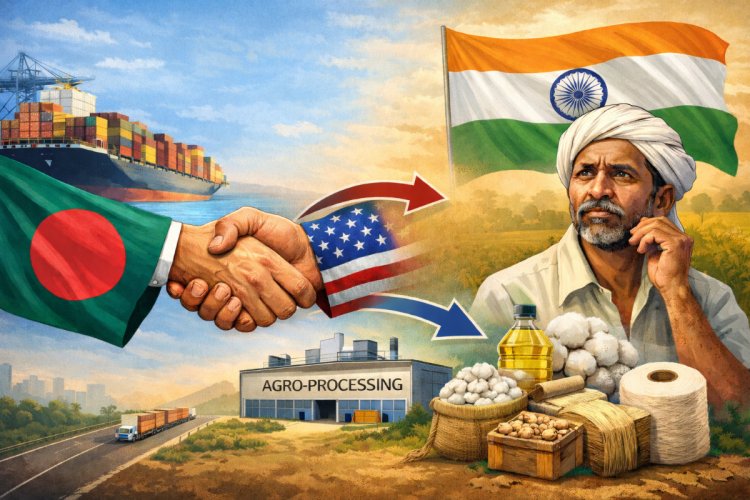
The new US-Bangladesh trade deal may appear to be bilateral, but its impact could reach across India’s agriculture sector. Preferential access to US agricultural commodities in Bangladesh raises concerns about re-exports through SAFTA channels, potentially putting pressure on India’s edible oil, cotton and feed markets.
The new trade deal between Washington and Dhaka is being presented as a victory for American farmers. Below Agreement between the United States of America and the People’s Republic of Bangladesh on Reciprocal TradeBangladesh is committed to providing preferential access to US agricultural goods, eliminating non-tariff barriers, and recognizing US sanitary and phytosanitary certifications.
On paper, it’s a bipartisan story.
In practice, this may not happen.
For India, the real issue is not what the United States exports to Bangladesh. This is what Bangladesh could eventually export to India – and in what form.
What the deal means for US agricultural exports
The agreement provides preferential treatment for US wheat, soybeans, soy oil, dairy products, beef, poultry, tree nuts, fruits and cotton. Bangladesh has promised to recognize US regulatory certifications and ensure that its SPS measures are science-based rather than protectionist.
The commercial understanding referenced with the agreement points to agricultural purchases – including wheat, soy and cotton – worth an estimated $3.5 billion.
For American grain traders and oilseed exporters, it has now become easier to enter Bangladesh’s 175 million-person market. However, the concern for India is on the downside.
Bangladesh is not just a consumption market. It is also a processing and re-export platform within South Asia.
SAFTA loophole concern
Both India and Bangladesh are members of the South Asian Free Trade Area. Under SAFTA, less-developed members like Bangladesh enjoy preferential tariff access to India provided the goods meet the criteria of rules of origin – typically 30-40 per cent value addition or substantial transformation.
The principle is simple: the goods must actually originate in the exporting country.
This practice is vague.
If US soybeans are crushed into oil in Bangladesh, or US wheat is milled into flour, or dairy inputs are processed into packaged food, do they qualify as of Bangladeshi origin? In many cases, yes – if value-added limits are met and the tariff classification changes.
This is where India’s agricultural sensitivities come to the fore.
India remains structurally weak in terms of edible oils. The country imports more than 60 percent of its edible oil consumption. Domestic oilseed farmers are already struggling with price volatility. A scenario in which competitively priced US soy oil enters Bangladesh, is processed, and then shipped to India at concessional SAFTA tariffs is not far-fetched.
The same logic can apply to poultry feed, processed dairy inputs and specialty grains.
Business Economist Prof. Biswajit Dhar puts it clearly:
“India needs to strengthen rules of origin, and tighten surveillance at ports, which is lax at the moment. If not, there is a possibility of US agricultural products entering the country.”
His warning is not rhetorical. This reflects long-standing concerns about enforcement capacity.
Port vigilance and precedents
Indian customs enforcement under the preferential trade regime has often been uneven. Verification of value addition is paperwork-heavy and vulnerable to under-invoicing or creative accounting.
While outright transshipment – simple repackaging of US almonds or pulses and sending them to India – would not qualify under SAFTA, intermediate processing changes the equation.
And Bangladesh’s industrial base is growing.
Significant agro-processing and food packaging facilities already operate in the country. If US agricultural commodities enter on a larger scale under preferential tariffs and reduce SPS frictions, Bangladesh could develop as a regional processing hub.
This will change the competitive landscape for Indian farmers, especially in oilseeds and fodder inputs.
cotton dimensions
Cotton adds another layer.
Bangladesh’s textile industry is the world’s second largest exporter of finished garments. It imports almost all its raw cotton. The US is already a major supplier, and the new agreement is on favorable terms.
If US cotton becomes more competitive than Indian cotton, Bangladesh mills may change sourcing patterns. Indian cotton exporters – already troubled by domestic procurement policies and global price volatility – will face additional headwinds.
Given that India and Bangladesh compete in global apparel markets, lower input costs in Dhaka translate into sharper competition for Indian manufacturers.
The impact will be indirect but real.
Bangladesh-India Trade: Baseline
Bangladesh exports about $1.8-2 billion worth of goods to India annually. Agricultural and agro-processed commodities include fish, jute products, processed foods and select edible oil shipments.
India’s exports to Bangladesh are much larger, especially of rice, wheat, sugar, onion and cotton. The balance of trade is in favor of India.
But that surplus does not eliminate regional vulnerabilities.
Trade flows do not have to be large to be disruptive. Entry of a few lakh tonnes of competitively priced edible oil or feedstock through preferential channels could reduce domestic prices in sensitive states.
Agricultural politics in India is rarely forgiving.
strategic undercurrents
This agreement is not limited to tariffs. Bangladesh has also committed to aligning more closely with US economic security priorities, including cooperation on export controls and addressing below-market practices by third countries.
This positions Bangladesh more firmly in the US-led supply chain framework.
For India, the geopolitical implications are mixed. Closer US-Bangladesh ties could reduce China’s influence in Dhaka. But preferential US agricultural access creates competitive distortions within South Asia.
India itself has opposed deep agricultural concessions in trade negotiations ranging from Regional Comprehensive Economic Partnership to bilateral FTAs, precisely because of rural sensitivities.
Now, it faces a scenario in which concessions made by Dhaka to Washington could indirectly test India’s own trade security.
Policy test for New Delhi
The response does not have to be confrontational. But this cannot be satisfied.
First, India will need to strictly enforce SAFTA rules of origin, including digital tracking of value chains and robust post-clearance audits.
Second, customs surveillance at ports should be tightened – not selectively, but systematically.
Third, India may have to rethink its edible oil and oilseeds strategy. Dependence creates insecurity. Vulnerability invites pressure.
The US-Bangladesh agreement is not a direct attack on Indian agriculture. It’s more subtle than that.
This is a structural shift in incentives – a shift that, if not addressed, could open side doors instead of front doors.
Trade agreements rarely cause immediate shocks. They quietly and incrementally reshape supply chains. And by the time the farmers come to know, the consignment has already arrived.